

Verifiable Digital Certificates for Maritime Skills
What makes a skill certificate trustworthy, and how an employer confirms one in under ten seconds.
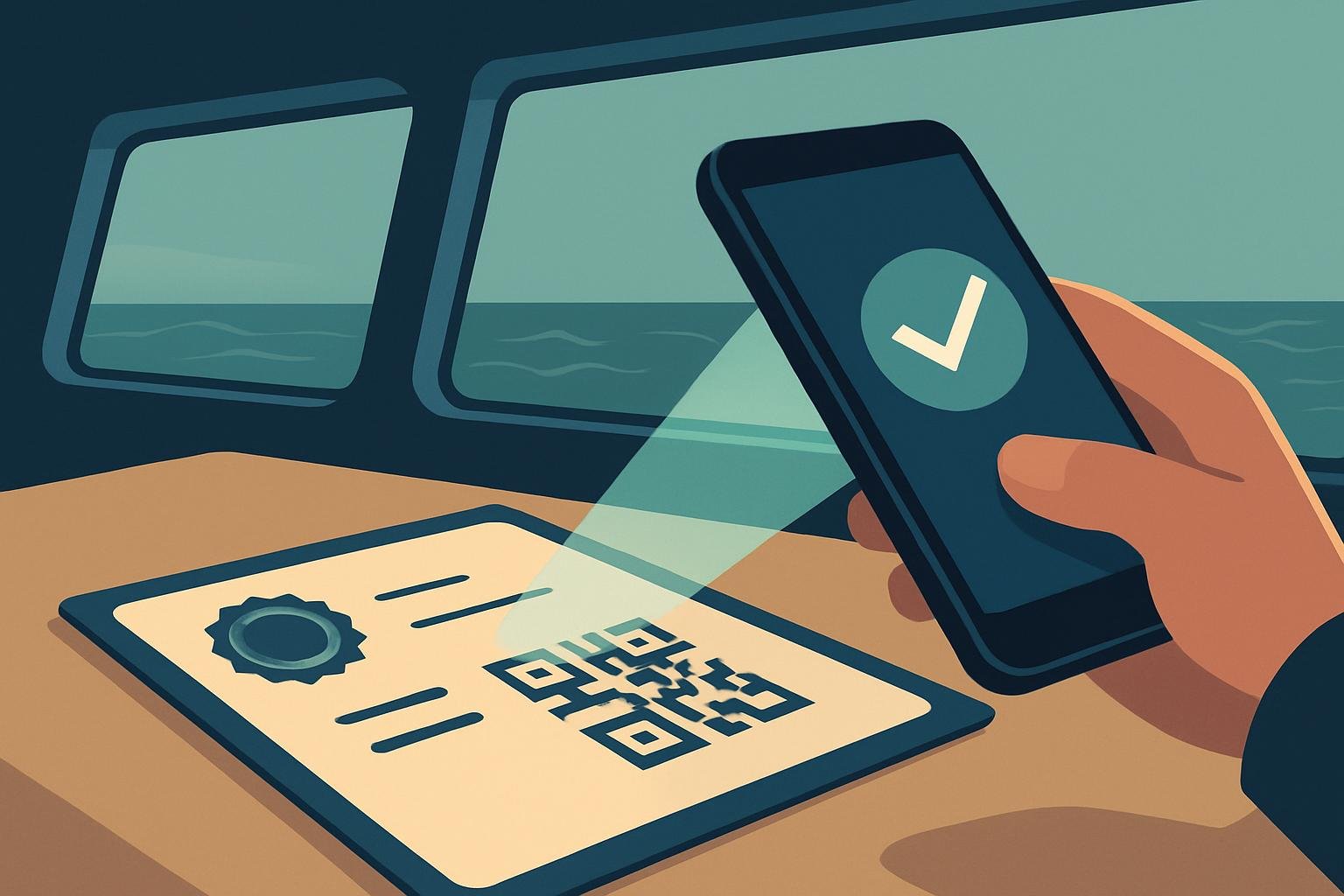
A verifiable digital certificate is one that a stranger can check without phoning the issuer. That is the whole idea, and it is rarer than it should be. Most certificates attached to a shipping resume are PDFs or scans that prove nothing beyond the applicant’s ability to attach a file. This guide shows how a Marine Ideas skill certificate is earned, how it is signed, and how an employer confirms one in a few seconds.
One point first, because it matters. These are skill certifications. They show that a person passed a proctored knowledge exam in a defined area such as laytime and demurrage or port agency coordination. They are not statutory certificates of competency under the IMO’s STCW Convention, and they do not replace them.
The problem with a PDF in an inbox
A recruiter looking at a certificate has three questions.
- Was it issued by who it says?
- Was it issued to this person?
- Is it still valid?
A plain PDF answers none of them. Layouts can be copied, names can be edited, and a certificate that was withdrawn last month looks identical to one that was not. The usual fix is to email the issuer and wait, which nobody does for a first-round shortlist. So certificates get ignored, and the candidates who earned them get no credit.
A certificate becomes useful only when checking it is quicker than doubting it.
What you need
- For candidates: a free account, a completed profile with a reference photo, a webcam and about an hour.
- For employers: nothing. Verification is public and needs no account.
Step 1: Choose a certification
Certifications are organised by skill group, with one certification per group. Groups follow maritime company types, so the catalogue for Bulk Carriers includes areas such as charter party management and voyage accounting, while the catalogue for Feeders leans towards agency and port operations. Some certifications are general and apply to every company type.
You can browse the public certification catalogue before signing up. Each entry describes what the skill group covers.
Common mistake: picking the certification with the most impressive title. Pick the one that matches the job you want. An employer reading your profile is looking for evidence about a specific seat.
Step 2: Lock a reference photo
Before your first attempt, you upload a clear, front-facing photo. It is checked automatically for usability and then locked. Every webcam snapshot taken during an exam is compared against it.
Locking matters. If the reference could be swapped before each attempt, the comparison would mean nothing. This is the step that ties the certificate to a person and not just to an account.
Step 3: Take the proctored exam
Each certification states its number of questions and its time limit before you start, so you know what you are committing to. Budget up to an hour. The questions are drawn from a maritime question bank of more than 59,000 items, sampled fresh for each attempt and shuffled, so two candidates do not sit the same paper in the same order.
The mix is fixed so that every attempt tests the same balance of skills.
| Question type | Share of the exam |
|---|---|
| Multiple choice, one correct answer | 70% |
| Multiple choice, several correct answers | 15% |
| Fill in the blank | 10% |
| Written answer | 5% |
During the exam, the browser takes periodic webcam snapshots and records when you switch away from the exam tab. Recruiters and administrators see these as integrity signals alongside the score.
What you should see: a timer, one question at a time, and your answers saved as you go. A page refresh does not lose your progress.
Step 4: Scoring
Multiple choice and fill in the blank answers are scored by fixed rules against the answer key. Written answers are graded by a language model against a marking rubric that is stored with each question. You see your score, and you can review every question with the correct answer and an explanation.
There is a cap on attempts, three by default. A certificate you could retake without limit until you passed would tell an employer very little.
Step 5: Download the certificate
A passing attempt produces a PDF certificate. It carries your name, the skill group, the score, the date and a QR code. The PDF is the convenient part. The QR code is the part that makes it a verifiable digital certificate.
How an employer checks a verifiable digital certificate
Scan the QR code, or follow the link on the certificate. It opens a public verification page on marineideas.com. No login, no email to the issuer.
The page shows:
- Whether the certificate is authentic.
- Who it was issued to and for which skill group.
- The score breakdown.
- Whether it has been revoked.
That is the ten second check. If the page says valid, the details on it are the record. If the PDF in your inbox says something different from the page, trust the page.
Why the link cannot be guessed or forged
Each verification link contains a signed token. The signature is created with a secret key held only on the server, and it is checked before any record is looked up. Change one character of the link and the signature no longer matches, so the page refuses it.
This closes the two obvious attacks. Nobody can edit a link to point at somebody else’s passing result, and nobody can walk through the links in sequence to harvest other people’s scores.
Revocation
Certificates can be withdrawn. An organisation that issues certificates from its own job exams can revoke one, for example when an integrity review overturns a result. From that moment the verification page reports the certificate as no longer valid, even though the PDF still exists on someone’s laptop. A paper certificate cannot do that.
Where certificates show up
A certificate that sits in a downloads folder is not doing much. Three places put it to work.
- Your public profile. Candidates can publish a profile page with a shareable link and QR code. It shows your best passing result for each certification, and only passing results.
- The talent pool. Recruiters browsing candidates see certification standing next to the resume. Organisations can also view a leaderboard ranked by certifications earned.
- Your team. Organisation administrators can see the certifications their own members have earned, which is useful for training plans and internal moves.
For employers: building verification into hiring
Checking a certificate is quick. Making it a habit takes a small change to your process.
- Ask for the link, not the file. In your job advert or first reply, ask candidates to send the verification link for any skill certificate they hold. It saves you from handling attachments you cannot check.
- Check at shortlist, not at offer. Verification takes seconds, so do it before the interview. It changes which questions are worth asking.
- Read the breakdown, not only the pass. The verification page shows scores by skill area. Two candidates who both passed can have very different profiles, and the weaker areas make good interview topics.
- Record what you saw. Note the date you verified. A certificate that was valid at shortlist could be revoked later, and your record shows you checked.
If you issue certificates from your own job exams, you also set the pass mark and the organisation name that appears on the certificate.
What a skill certificate does and does not prove
It is worth being exact here, because overclaiming is how certificates lose their value.
| It shows | It does not show |
|---|---|
| The named person passed a proctored knowledge exam in a defined skill group | Statutory competency under STCW or any flag state |
| The score, and whether it met the pass mark | Years of experience or seniority |
| That the result has not been revoked | How the person performs under operational pressure |
| The date of the attempt | That the knowledge is current several years later |
Used properly, a skill certificate sits between the resume and the interview. The resume is a claim. The certificate is tested evidence for one part of that claim. The interview explores the rest. If you are building a hiring process, our guide to how AI resume screening works for maritime roles covers the step before, and how an AI voice interview works covers the step after.
Troubleshooting
The exam will not start. Check that your profile has a confirmed reference photo. An attempt cannot begin without one.
The verification page says the link is invalid. The link was probably cut off when it was copied from an email. Scan the QR code on the PDF instead.
The page says revoked. The issuer has withdrawn the certificate. The candidate should contact the organisation that issued it.
You have used all your attempts. The cap is there to keep the result meaningful. Use the answer review from your attempts to study the areas you missed.
Start with one
If you are a candidate, pick the certification that matches the role you are applying for and add the verification link to your resume. If you are a recruiter, ask shortlisted candidates for a verification link and not a PDF. Try Marine Ideas free. No credit card is required.