

Short-Lived Freedom: Trump Suspends Hormuz Corridor After CMA CGM Strike
A missile strike on a CMA CGM boxship has forced the suspension of the U.S.-led 'Project Freedom' corridor, leaving the Strait of Hormuz in a volatile state.
TL;DR
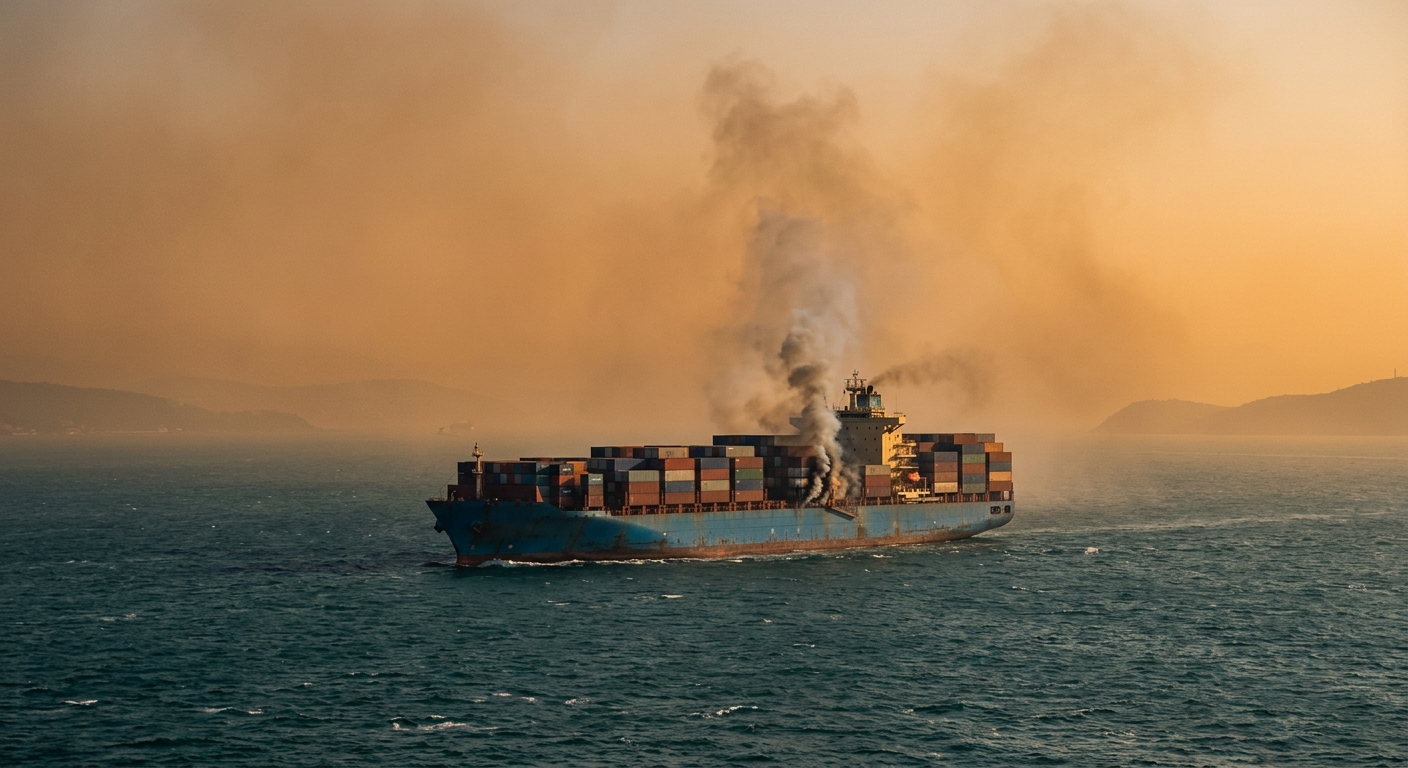
A potential cruise missile strike on the CMA CGM San Antonio has left several crewmembers injured and forced the vessel to go dark near Dubai.
President Trump has officially paused "Project Freedom," a two-day-old maritime security corridor, citing a shift toward diplomatic negotiations.
While the security "umbrella" for merchant ships is suspended, the U.S.-led blockade on Iranian maritime traffic remains in full force.
A cruise missile tore into the hull of the CMA CGM San Antonio on Tuesday, shattering the brief illusion of safety promised by the newly minted "Project Freedom" corridor. The Maltese-flagged boxship, now silent and invisible to tracking systems, became the latest casualty in a high-stakes game of maritime chicken in the Strait of Hormuz. Hours after the strike, the White House hit the brakes on its security initiative, trading tactical escorts for the uncertain waters of diplomatic negotiation. This sudden reversal leaves the world’s most critical energy chokepoint in a state of volatile suspension, where the only certainty is the ongoing blockade of Iranian hulls.
The Kinetic Reality of the San Antonio Strike
The CMA CGM San Antonio was navigating the treacherous waters off Dubai when the projectile struck. While initial reports from the UK Maritime Trade Operations (UKMTO) were vague, U.S. officials now suggest a cruise missile was the likely culprit. This represents a significant escalation from the drone-based harassment seen in previous months. The strike was precise enough to cause structural damage and injure multiple crewmembers, though the full extent of the casualties remains guarded by the carrier for privacy and security reasons.
Following the impact, the vessel’s Automatic Identification System (AIS) went silent. This "going dark" maneuver is a standard defensive protocol in high-threat environments, designed to prevent secondary strikes by denying the adversary real-time tracking data. However, it also creates a vacuum of information for logistics managers and port operators down the line. The ship was last localized near the Omani sector of the strait, a region that was supposed to be the heart of the protected "Project Freedom" corridor.
The use of a cruise missile implies a level of sophistication that bypasses basic shipboard defenses. Unlike slow-moving loitering munitions, a cruise missile offers high speed and a larger warhead, capable of disabling a modern ultra-large container vessel. For the maritime industry, this raises the stakes significantly. If a Maltese-flagged vessel operated by a major French carrier is not safe within a designated security zone, then the fundamental calculus of transit risk in the Middle East has shifted.
The Forty-Eight Hour Security Umbrella
Project Freedom was designed to be a definitive answer to Iranian interference in the Strait of Hormuz. The initiative promised a military "umbrella" for merchant ships, providing a clear path for vessels trapped in the Arabian Gulf to reach the open sea. By utilizing the Omani sector of the strait, the U.S.-led coalition hoped to create a predictable, defensible lane that would stabilize soaring insurance premiums. Instead, the project lasted exactly two days before the San Antonio strike forced a total strategic re-evaluation.
President Trump’s characterization of the program as a "tremendous military success" stands in stark contrast to its rapid suspension. From a tactical perspective, the corridor may have succeeded in flushing out Iranian battery positions, but for the commercial shipping industry, the results were less convincing. The fact that participants and non-participants alike were targeted suggests that the "umbrella" was either too small or too porous to deter a determined adversary. The suspension signals that the cost of maintaining the corridor—both in military assets and diplomatic capital—had become too high to sustain.
The "pause" is officially attributed to a request for diplomatic breathing room. Pakistan and other regional stakeholders reportedly urged the U.S. to de-escalate to avoid a wider regional conflagration. This diplomatic pivot suggests that the maritime security corridor was being used as a bargaining chip in a much larger geopolitical poker game. For shipowners, however, diplomacy is a slow-moving shield. The immediate result of the pause is a return to the status quo: every captain for themselves in one of the world's most dangerous waterways.
The Tech Angle: The Risks of Going Dark
When a vessel like the CMA CGM San Antonio disables its AIS, it enters a "ghost" state. While this protects the ship from radar-homing missiles and visual tracking by adversaries, it creates a massive safety hazard in the crowded Strait of Hormuz. Without AIS, collision avoidance relies entirely on bridge lookouts and active radar, which can be spoofed or cluttered by regional military activity. For the global supply chain, this lack of visibility triggers a domino effect of delayed berthing windows and inaccurate ETA data.
A Blockade in Search of a Negotiation
While Project Freedom is on ice, the U.S. blockade of Iranian maritime traffic remains in full effect. This asymmetric approach creates a peculiar tension in the Strait. The U.S. is effectively attempting to stop Iranian oil and goods from leaving the Gulf while simultaneously struggling to protect neutral commerce entering it. This "maximum pressure" tactic at sea has forced Iran into a corner, and the strike on the San Antonio is a clear signal that they are willing to disrupt global trade to break the siege.
The blockade's effectiveness is a matter of intense debate among maritime analysts. While it has undoubtedly squeezed the Iranian economy, it has also turned the Strait of Hormuz into a shooting gallery. By targeting a high-profile European-operated vessel like the San Antonio, Iran is demonstrating that the cost of the blockade will be shared by the global community. They are betting that the pain of disrupted supply chains and injured seafarers will eventually force the U.S. to the negotiating table.
This strategy of "negotiation through escalation" appears to be working, at least in the short term. The transition from a military corridor to "diplomatic negotiations" is exactly what the Iranian leadership sought. By creating enough chaos to make Project Freedom untenable, they have forced a pause in the U.S. naval posture. The challenge for the Trump administration now is to negotiate from a position of perceived strength while their primary maritime security initiative is sidelined.
The Pakistani Gambit and Regional Stability
The involvement of Pakistan as a primary advocate for the "pause" highlights the complex regional alliances at play. Islamabad maintains a delicate balancing act between its strategic partnership with the U.S. and its shared border with Iran. A full-scale maritime war in the Strait of Hormuz would be catastrophic for Pakistan’s energy security and economic stability. By stepping in as a diplomatic intermediary, Pakistan is attempting to prevent a localized skirmish from evolving into a regional catastrophe that could draw in other Gulf powers.
Other regional players, including the UAE and Oman, are likely watching with bated breath. Oman, in particular, finds itself in a difficult position as the "Project Freedom" corridor was specifically routed through its territorial waters. The sultanate has long prided itself on being the "Switzerland of the Middle East," maintaining neutrality even in the darkest hours of regional conflict. The failure of the corridor and the subsequent missile strike on the San Antonio within Omani-adjacent waters is a blow to the perceived security of these neutral zones.
The "mutual agreement" mentioned by the White House suggests that the pause is not merely a U.S. retreat, but a coordinated regional effort to lower the temperature. However, for the crews of the hundreds of tankers and boxships currently transiting the region, "lowering the temperature" is a cold comfort. They remain the primary targets in a conflict they did not start. The diplomatic window is now open, but if it fails to produce a concrete agreement on maritime transit, the return to kinetic action is almost guaranteed.
"The difference between a protected corridor and a combat zone is often just a single well-aimed missile."
The Heavy Price of War Risk Premiums
The strike on the CMA CGM San Antonio has sent shockwaves through the London insurance market. War risk premiums for the Arabian Gulf were already elevated, but the use of cruise missiles against a top-tier container carrier changes the risk profile entirely. Underwriters are now forced to consider the possibility of total hull loss for ultra-large vessels, a scenario that would dwarf the payouts seen in the Red Sea or the Black Sea. For freight forwarders, these costs are inevitably passed down as "Emergency Risk Surcharges," adding yet another layer of inflation to global trade.
Dubai, the last known location of the San Antonio, finds itself at the center of this logistics storm. As the region’s primary transshipment hub, any disruption to the Strait of Hormuz threatens the viability of Jebel Ali. If carriers begin to bypass the Gulf entirely to avoid the "Hormuz tax," the economic impact on the UAE would be profound. We are seeing a burgeoning trend where cargo is being offloaded at ports outside the Strait, such as Salalah or Sohar, and then trucked overland—a costly and inefficient alternative that cannot handle the sheer volume of modern container trade.
The competitive landscape between carriers is also shifting. Companies with higher risk tolerances or those with specific state-backed security arrangements may continue to ply the Hormuz route, while others divert. CMA CGM, as a French-headquartered giant, has historically relied on the protection of the French Navy in similar hotspots. The fact that the San Antonio was struck despite these traditional safety nets suggests that the old rules of maritime deterrence are being rewritten. Carriers are now evaluating whether the revenue from Gulf calls is worth the potential loss of a billion-dollar asset and the lives of their seafarers.
Echoes of the Tanker War: A Historical Precedent
The current volatility in the Strait of Hormuz is not without precedent. Industry veterans often point to the "Tanker War" of the 1980s, during the Iran-Iraq conflict, as the last time commercial shipping faced such a sustained and systematic threat. During that era, over 500 ships were attacked, and the U.S. eventually launched Operation Earnest Will to escort Kuwaiti tankers. The lesson from that decade was clear: naval escorts can protect individual ships, but they cannot guarantee the safety of the entire waterway.
The failure of Project Freedom after just 48 hours suggests that modern anti-ship weaponry has outpaced traditional convoy tactics. In the 1980s, ships were targeted by relatively simple mines and unguided rockets. Today, the threat includes precision-guided cruise missiles, ballistic missiles, and swarms of suicide drones. The defensive "umbrella" required to protect a 400-meter-long container ship against these threats is massive, requiring constant Aegis-level radar coverage and rapid-response interceptors. For a merchant fleet of thousands, providing this level of security is a logistical impossibility for any single navy.
Furthermore, the "Tanker War" eventually ended through exhausted diplomacy rather than military victory. This historical context provides some insight into why President Trump may have been so quick to pivot toward negotiations. If the alternative is a multi-year naval campaign with no guaranteed end to the missile strikes, a "pause" for diplomacy becomes the more attractive option for a White House wary of "forever wars." However, until a formal agreement is reached, the shipping industry remains in the crosshairs, much as it was forty years ago.
The Supply Chain Domino Effect: Beyond the Strait
The strike on the CMA CGM San Antonio is not just a localized tragedy; it is a systemic shock to the global supply chain. When a vessel of this size is taken out of rotation, it creates an immediate capacity gap. In the current "just-in-time" logistics environment, a single missing ship can lead to weeks of blank sailings and equipment shortages at both ends of the trade lane. Freight forwarders are already scrambling to find alternative space for cargo that was destined for the San Antonio’s next port of call.
Furthermore, the decision for ships to "go dark" and turn off AIS creates a massive data gap for global logistics networks. Without real-time tracking, port operators cannot accurately plan for labor, berth space, or yard capacity. This uncertainty ripples through the entire network, causing congestion in ports as far away as Singapore and Rotterdam. The maritime industry is built on the premise of predictable schedules, and the current chaos in the Hormuz is the antithesis of that predictability.
We are also seeing a shift in carrier behavior as they prioritize crew safety over schedule integrity. Many carriers are now implementing "slow steaming" or taking longer routes to stay within protected zones as long as possible. This reduces effective global capacity and drives up freight rates. For shippers, the "Hormuz Pause" means that the cost of doing business in the Middle East has just become significantly more expensive and significantly less reliable. The industry is now entering a period of forced adaptation, where agility is the only defense against geopolitical instability.
The Regulatory and Legal Quagmire of the Strait
The fact that the CMA CGM San Antonio is a Maltese-flagged vessel adds a layer of complexity to the international response. Under maritime law, the flag state has the primary responsibility for the safety and security of its vessels. However, Malta lacks the naval power to project force in the Strait of Hormuz, highlighting the disconnect between the commercial "flags of convenience" system and the reality of modern geopolitical conflict. This leaves the protection of the global fleet in the hands of a few major powers, who may or may not share the same strategic priorities as the shipowners.
The U.S. blockade of Iranian traffic also raises significant questions under the UN Convention on the Law of the Sea (UNCLOS). While the U.S. is not a signatory to UNCLOS, it generally adheres to its principles of "innocent passage" and "transit passage" through international straits. By maintaining a blockade while suspending a security corridor for neutral ships, the administration is walking a fine legal line. This selective enforcement of maritime law creates a precedent that other regional powers may choose to exploit in the future, further eroding the rules-based order that has governed the seas since 1945.
For the legal departments of major carriers, the current situation is a nightmare of force majeure clauses and insurance disputes. If a ship is struck while participating in a government-sponsored security corridor that is suddenly "paused," who bears the liability? These questions will likely be litigated for years in maritime courts. In the meantime, the industry is left to navigate a legal and physical landscape where the old protections no longer apply, and the new ones are subject to the whims of diplomatic negotiation.
How Exaqube Helps
The sudden "going dark" of vessels and the suspension of security corridors create an information vacuum that traditional tracking tools cannot fill. This is precisely why ScheduleSense is critical for modern logistics managers. By aggregating carrier-direct data and cross-referencing it with satellite imagery and historical patterns, ScheduleSense provides alerts on blank sailings and schedule changes before they cripple your operations. Meanwhile, DataSense integrates this real-time volatility directly into your ERP, allowing you to visualize the financial impact of rerouting and war risk surcharges. In an era where the "Hormuz tax" is the new normal, having a single source of truth for your operational data is the only way to maintain a competitive edge.
The pause in Project Freedom is a sobering reminder that naval power alone cannot secure the world's most volatile waterways. As the CMA CGM San Antonio limps toward safety, the maritime industry must prepare for a prolonged period of diplomatic uncertainty and tactical risk. The coming weeks will reveal whether the "pause" leads to a meaningful de-escalation or simply provides a window for adversaries to regroup. For now, the Strait of Hormuz remains a high-stakes corridor where the cost of passage is measured in both dollars and lives.
Originally reported by [maritime-executive.com](https://maritime-executive.com/article/after-attack-on-cma-cgm-boxship-trump-suspends-new-hormuz-transit-corridor)
Originally published at maritime-executive.com.