

Project Freedom: Washington Stakes 15,000 Troops on a Hormuz Exit Strategy
US launches Project Freedom to extract stranded ships from the Strait of Hormuz following Iranian attacks. A massive military escort mission begins.
TL;DR
US military initiates "Project Freedom" to escort merchant vessels out of the Arabian Gulf.
Escalation follows dual attacks on a tanker and a bulker by Iranian forces on May 3.
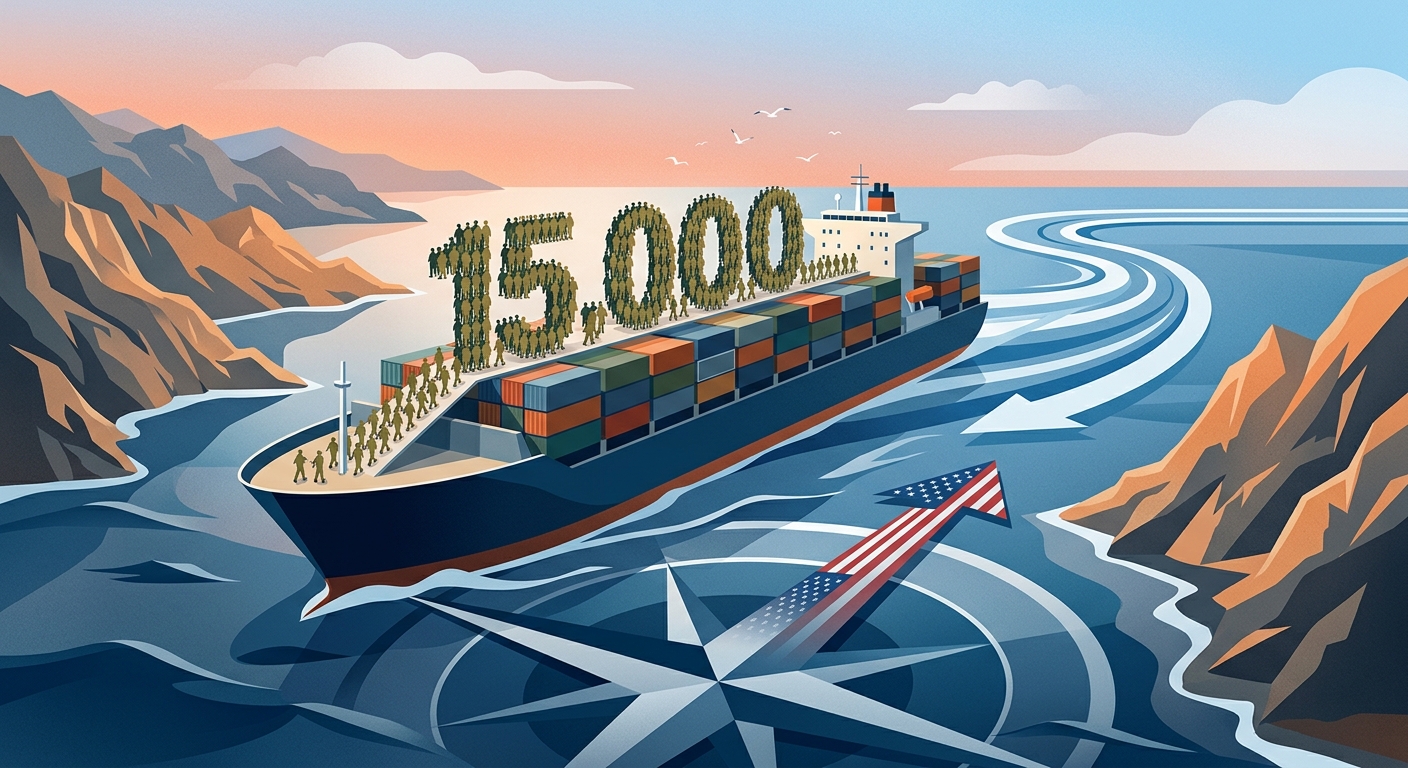
Massive deployment includes 100+ aircraft and 15,000 personnel to secure the chokepoint.
The Strait of Hormuz has transformed from a vital trade artery into a high-stakes shooting gallery. President Trump’s announcement of Project Freedom signals a shift from passive monitoring to active military intervention as 15,000 service members prepare to extract stranded tonnage. With tankers and bulkers currently dodging projectiles and swarm tactics, the global supply chain faces its most significant kinetic challenge since the 1980s. The maritime industry now waits to see if guided-missile destroyers can restore the predictable flow of energy through the world's most volatile chokepoint.
On May 3, the maritime world received a violent reminder of the Gulf's fragility. A tanker navigating 78 nautical miles north of Fujairah sustained damage from unknown projectiles at 19:40 UTC. Simultaneously, a bulker faced a swarm of small vessels near Sirik, highlighting the multi-vector threat Iranian forces now pose to commercial traffic. These are not isolated skirmishes; they are a coordinated attempt to paralyze the Strait.
The geographic spread of these attacks is particularly concerning for operations managers. The Fujairah incident occurred in the Gulf of Oman, traditionally considered a safer staging area outside the immediate chokepoint. By striking vessels both inside and outside the Strait, Iranian forces have effectively expanded the danger zone, forcing insurers to reconsider the boundaries of high-risk areas. The "wait and see" approach for many shipowners has officially expired.
Project Freedom: A Massive Extraction
The scale of Project Freedom suggests Washington is finished with half-measures. Deploying 15,000 service members alongside 100 aircraft and a fleet of guided-missile destroyers creates a formidable shield for merchant shipping. This is an extraction mission designed to clear the backlog of vessels currently trapped within the Arabian Gulf. The US military intends to provide a safe corridor, effectively turning the Strait into a guarded highway for stranded tonnage.
Observers note that 15,000 troops represent a significant logistical footprint for a maritime escort mission. This suggests the US is preparing for more than just a few days of escort duty; it indicates a long-term stabilization effort or a preparation for potential land-based anti-ship battery suppression. The inclusion of 100 aircraft provides the necessary "eyes in the sky" to spot small vessel swarms long before they reach their targets. For the crews currently anchored in the Gulf, this massive show of force is the only viable ticket out.
The Logistics of Convoy Operations
Convoying is an ancient art that modern shipping has largely forgotten. Organizing a fleet of VLCCs, LNG carriers, and bulkers into a cohesive unit requires more than just military might; it requires precise timing and communication. Each ship has different maneuverability characteristics and cruising speeds. A VLCC cannot stop on a dime if the ship ahead faces a drone strike, making the spacing of these convoys a critical engineering challenge.
Furthermore, the communication protocols between civilian crews and military command centers must be seamless. Most merchant sailors are not trained for combat maneuvers. Project Freedom will likely implement a 'Follow the Leader' protocol where a US Navy destroyer leads a string of 5-10 merchant vessels through the narrowest parts of the Strait. This reduces the surface area that the military must defend but increases the risk of a single incident blocking the entire channel.
The psychological toll on crew members cannot be understated. Sailing through a zone where a tanker was just hit by "unknown projectiles" requires a level of nerves that few in the civilian sector signed up for. While the presence of 100 aircraft overhead provides comfort, the reality of a 15,000-person military operation underscores the extreme danger of the current environment. This is no longer business as usual; it is a tactical evacuation of the world’s most important energy corridor.
"The Strait of Hormuz is only 21 miles wide at its narrowest point, but the shipping lanes are even tighter—leaving no room for error when projectiles start flying."
The Insurance Nightmare
The Joint War Committee (JWC) is likely working overtime as these incidents unfold. When a vessel is 'stranded' in a conflict zone, the insurance implications shift from standard hull and machinery to complex war risk clauses. Premiums for transiting the Arabian Gulf were already climbing, but Project Freedom introduces a new variable: government-backed security. While military escorts reduce the physical risk, they do not necessarily lower the financial burden for charterers who must pay for every hour a ship sits idle.
The definition of 'stranded' is also a point of contention. If a ship is physically able to move but is legally or practically barred by its insurers from entering the Strait, does it count as a total loss after a certain period? Lawyers will be debating these 'blocking and trapping' clauses for years. For now, the focus remains on the immediate safety of the hull and cargo, but the long-term litigation tail of these May 3 attacks will be immense.
Furthermore, the involvement of 15,000 US service members complicates the 'Act of War' exclusions found in many maritime contracts. If a vessel is damaged while under US military escort, does the liability sit with the owner, the flag state, or the US government? These are unchartered waters for the modern era. The industry is effectively watching a live-action stress test of maritime law and insurance endurance.
Historical Echoes of the Tanker War
Veteran mariners will recall the 1980s Tanker War, where over 500 ships were attacked in the Gulf. Back then, Operation Earnest Will saw the US Navy reflagging Kuwaiti tankers to provide protection. Project Freedom feels like a spiritual successor but with a much larger scope. In the 80s, the threat was largely from conventional missiles and sea mines; today, it includes autonomous drones and sophisticated swarm tactics from small, fast-attack craft.
The difference in 2026 is the speed of information. During the 1980s, an attack could happen, and the world might not know the details for days. Today, satellite imagery and AIS data provide a real-time view of the chaos. This transparency is a double-edged sword: it allows for better coordination but also causes immediate spikes in global oil prices and freight derivatives. The market reacts to a projectile hit before the smoke has even cleared from the deck.
The geopolitical stakes are also higher. In the previous century, the world was bipolar; now, it is multipolar. The US taking such a decisive lead with Project Freedom forces other major powers, including China and India—both major consumers of Gulf oil—to decide if they will join the escort mission or rely on Washington’s security umbrella. The silence from other capitals is deafening as the first convoys prepare to move.
The Tech Angle
Modern maritime security isn't just about big guns; it's about the electromagnetic spectrum. Project Freedom will likely utilize advanced jamming and electronic warfare suites to neutralize the drone threats that plagued the bulker near Sirik. For shipowners, this adds another layer of complexity: how do you maintain your own bridge electronics when a nearby destroyer is blanketing the area with high-powered signal interference? Coordination on the 'digital' escort is just as vital as the physical one.
Energy Market Fallout
The impact on global energy markets was instantaneous. Crude prices surged as news of the May 3 attacks broke, reflecting the 'Hormuz Premium' that traders haven't seen in years. Fujairah, the world’s third-largest bunkering hub, sits right at the mouth of this conflict. If vessels cannot safely reach the Fujairah offshore anchorage to refuel, the entire logistical chain for the East-West trade route begins to buckle.
We are seeing a massive redirection of tonnage. Ships that would normally wait for orders in the Gulf are now steaming toward the Red Sea or the Cape of Good Hope, despite the added costs. For those already 'trapped' inside, the value of their cargo is skyrocketing, but their ability to deliver it remains tethered to the success of Project Freedom. It is a bizarre market dynamic where a ship's value is high, but its liquidity—quite literally its ability to move—is zero.
Refineries in Asia and Europe are already bracing for a supply crunch. While strategic reserves can fill the gap for a few weeks, the long-term viability of the Arabian Gulf as a reliable energy source is being questioned in boardrooms across the globe. If 15,000 troops are required to keep the lights on, the cost of that energy has just fundamentally changed. The maritime industry is not just dealing with a security crisis; it is witnessing a massive repricing of global risk.
The Future of Gulf Trade
Beyond the immediate military extraction, Project Freedom raises questions about the long-term governance of the Strait. If the US is the only power willing to put skin in the game, does that give Washington a greater say in who gets to transit? This could have significant implications for the 'Shadow Fleet'—vessels operating outside traditional Western sanctions and insurance regimes. Would a US destroyer provide escort to a tanker carrying sanctioned oil? Unlikely.
This creates a two-tier shipping system in the Gulf. The 'White Fleet'—compliant, insured, and protected by Project Freedom—and the 'Shadow Fleet,' which must now navigate these waters at their own extreme peril. We may see a scenario where the shadow fleet is forced to hire private maritime security companies (PMSCs) or simply risk total loss. The divergence in safety and cost between these two groups will only widen as the conflict persists.
Ultimately, the success of Project Freedom will be measured not just by the number of ships it extracts, but by the stability it restores. If the attacks continue despite the presence of 100 US aircraft, the maritime industry will have to accept that the Strait of Hormuz is no longer a standard commercial waterway. It will have become a permanent war zone, requiring a permanent military presence—a cost that will eventually be passed down to every consumer at the pump. This is the new reality of maritime logistics: security is no longer a given; it is a premium service.
How Exaqube Helps
The volatility in the Strait of Hormuz is exactly why ScheduleSense is critical for modern logistics managers. It provides real-time tracking of vessel movements and instant alerts for the route diversions and blank sailings that are now inevitable as Project Freedom begins. Furthermore, for those with hazardous materials on stranded ships, DGSense ensures that IMDG compliance and documentation remain accurate even as transit times double and storage conditions change. When the military takes over the schedule, having automated, AI-powered visibility into your cargo's status is the only way to maintain operational control. For freight forwarders caught in this crossfire, the difference between a panicked client and a prepared one is the data provided by DataSense.
The coming weeks will determine if Project Freedom is a temporary fix or the start of a new era in maritime security. As the first convoys assemble, the world’s eyes are on the Strait, watching for any sign of Iranian de-escalation or further provocation. For now, the maritime industry must adapt to a landscape where destroyers are as common as tugboats. The true test of this mission will be the first merchant vessel that successfully clears the Strait under the shadow of a US missile battery. We are entering a phase where the freedom of navigation is no longer a self-evident right, but a militarily enforced privilege.
Originally reported by [seatrade-maritime.com](https://www.seatrade-maritime.com/security/trump-announces-hormuz-evacuation-plan-for-stranded-ships)
Originally published at seatrade-maritime.com.