

Kinetic Diplomacy: US Navy Disables Iranian VLCC as Operation Epic Fury Targets Hormuz Blockade
The US Navy has escalated Operation Epic Fury by disabling the Iranian VLCC Hasna, as a dual-blockade in the Strait of Hormuz puts the global shipping industry
TL;DR
The US Navy has transitioned to offensive 'kinetic' actions, disabling the Iranian VLCC Hasna as part of Operation Epic Fury to break the Strait of Hormuz blockade.
Merchant shipping is caught in a dual-blockade crossfire, with both US and Iranian forces firing on or diverting commercial vessels to assert territorial claims.
The operational risk for Gulf transits has reached critical levels following strikes on CMA CGM and ADNOC-affiliated vessels, forcing 51+ ships to abandon their routes.
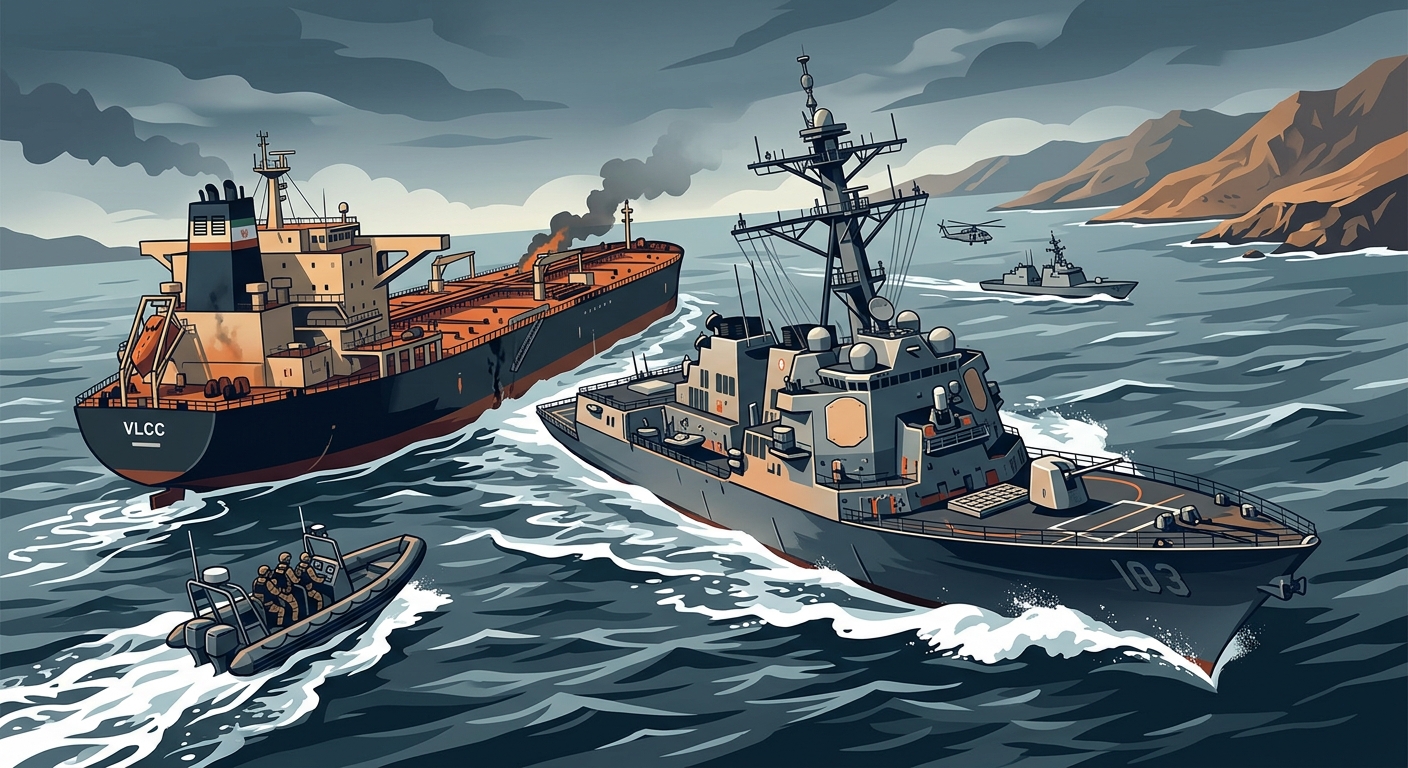
A US Navy jet just delivered a permanent mechanical failure to the Iranian VLCC Hasna, signaling a violent shift in the contest for the Strait of Hormuz. This precision strike, part of the broader Operation Epic Fury, effectively transforms the world's most critical energy chokepoint into a live-fire laboratory for maritime blockade enforcement. As the US administration ties the cessation of hostilities to a nebulous diplomatic agreement, the shipping industry is left to navigate a waterway where the rules of engagement are rewritten in real-time by anti-ship missiles and carrier-based aircraft. The message from Washington is clear: the era of passive escorting has ended, and the era of disabling the opposition has begun.
The Tactical Disabling of the Hasna
The US Navy’s strike on the Hasna, a Very Large Crude Carrier (VLCC) flying the Iranian flag, represents a calibrated escalation in naval warfare. Unlike traditional anti-ship strikes designed to sink a target, this operation focused on disabling the vessel—likely targeting the propulsion systems or steering gear to render the ship a literal dead weight in the water. This tactic avoids the catastrophic environmental fallout of an oil spill while effectively removing the asset from the board. It follows the precedent set on April 19, when US forces fired into the engine room of the Iranian container ship Touska before boarding and seizing it.
The technical precision required to disable a 300,000-deadweight-ton tanker without breaching its double hull is significant. US Centcom appears to be utilizing specialized munitions or high-precision targeting to ensure the vessel remains buoyant but immobile. This kinetic boarding strategy serves a dual purpose: it demonstrates overwhelming military superiority and creates a physical obstacle that Iran must now deal with using its own limited salvage resources. For the shipping community, this confirms that the US is no longer content with merely deterring attacks; it is now actively dismantling the infrastructure of the Iranian blockade.
This shift in tactics suggests that the US Navy is operating under a much wider mandate than previous freedom of navigation operations. By targeting the Hasna, the US is directly challenging Iran’s ability to export its primary commodity while simultaneously enforcing its own counter-blockade. The move essentially tells the market that any vessel perceived as contributing to the Iranian blockade or violating US directives is a legitimate target for disabling actions. This creates a terrifying precedent for commercial operators who might find their vessels caught in the crosshairs of a precision strike intended to disable rather than destroy.
The political scaffolding for these actions is built on Operation Epic Fury, a mission whose name suggests a departure from the more restrained Operation Prosperity Guardian. The US administration’s recent communications have linked the intensity of these military operations directly to diplomatic concessions from Tehran. By stating that the blockade would end only if Iran agrees to give what has been agreed to, the administration is using maritime force as a primary lever in high-stakes negotiations. This fusion of tactical naval strikes with real-time diplomacy creates an unpredictable environment for global trade.
The big assumption mentioned by the President—that Iran will actually agree to these terms—highlights the fragility of the current situation. Operation Epic Fury appears to be a maximum-pressure campaign taken to its logical, kinetic conclusion on the high seas. While the US aims to break Iran’s closure of the Strait, it is simultaneously enforcing its own set of rules, creating a paradoxical situation where the waterway is both closed and open depending on who is doing the asking. This dual-blockade reality means that merchant vessels are no longer just collateral damage; they are the primary medium through which this geopolitical struggle is being fought.
For the maritime industry, the lack of a clear, stable regulatory framework during Operation Epic Fury is the greatest challenge. When naval forces are directed by evolving political mandates and big assumptions, the traditional predictability of maritime law evaporates. Carriers are left to guess which vessels will be escorted and which will be directed to turn around by Centcom. The 51 ships already turned back by the US blockade represent a massive disruption to scheduled services, creating a backlog that will ripple through global supply chains for months, regardless of whether a diplomatic agreement is reached.
"As of May 5, the US Centcom blockade has forcibly redirected 51 merchant vessels, effectively severing one of the world's most vital maritime arteries."
The human and material cost of this conflict is mounting rapidly among the commercial fleet. On May 5, a CMA CGM containership was struck by missiles while transiting the Strait, resulting in crew injuries and significant structural damage. This attack, attributed to Iranian forces, occurred just as the US was publicizing its plan to escort vessels through the waterway. The timing suggests a deliberate attempt by Iran to demonstrate that US protection is not a guarantee of safety. For crew members, the Strait has become a gauntlet where the flag on the stern or the nationality of the owner can determine whether they are targeted by a drone or a missile.
The violence is not limited to container ships. On May 3, a tanker owned by an ADNOC-affiliated company was hit by drones, and a bulker was harassed by Iranian fast craft. Even vessels at anchor are not safe, as evidenced by the explosion on the HMM Namu off the coast of the UAE on May 4. This multi-modal targeting—spanning tankers, bulkers, and boxships—indicates that the entire spectrum of maritime trade is now a target. The use of drones and fast craft by Iran, contrasted with the high-altitude precision strikes by the US, shows a massive asymmetry in tactics that only increases the danger for slow-moving commercial hulls.
The psychological impact on seafarers cannot be overstated. When a major carrier like CMA CGM suffers direct hits and injuries to its crew, the business as usual facade of the shipping industry crumbles. Many ship management companies are now facing internal revolts from crews who refuse to enter the High Risk Area (HRA) without significant hazard pay or, in some cases, at all. This labor tension, combined with the physical threats, is forcing a radical rethink of route planning. The Strait of Hormuz is no longer a routine passage; it is a combat zone where the price of entry is paid in steel and, increasingly, in blood.
The Strait of Hormuz is the world's most important oil transit chokepoint, with roughly 20% of the world’s liquid petroleum passing through its narrow waters daily. When the US Navy disables an Iranian VLCC like the Hasna, it isn't just an attack on a single ship; it is a direct intervention in the global energy supply chain. The Hasna, capable of carrying two million barrels of crude, represents a significant portion of Iran’s export capacity. By neutralizing such vessels, the US is tightening the noose on Iranian oil revenues, but the byproduct is a massive spike in market volatility and insurance premiums for every other tanker in the region.
The conflict is also shining a harsh light on the so-called shadow fleet—the aging, under-insured vessels used by sanctioned regimes to move oil. When these vessels are disabled or seized, the risk of environmental catastrophe increases, as they often lack the maintenance and oversight of the mainstream fleet. However, the current US strategy seems to prioritize tactical neutralization over environmental caution. This high-stakes gamble assumes that the precision of US strikes will prevent a major spill, but in the chaotic environment of the Strait, nothing is certain.
For global energy markets, the dual blockade is a nightmare scenario. While there is currently a global cushion in oil production, a sustained closure or high-intensity conflict in Hormuz would inevitably lead to a price surge. Traders are closely watching the Epic Fury operations for any sign of a permanent closure. If the US continues to turn back ships and Iran continues to strike at will, the Strait could become effectively impassable for commercial tonnage. This would force a massive redirection of oil flows, likely benefiting pipelines that bypass the Strait, but at a significantly higher logistical cost and lower volume.
The Regulatory Angle
Under the United Nations Convention on the Law of the Sea (UNCLOS), the Strait of Hormuz is an international waterway where transit passage should be unimpeded. However, both the US and Iran are currently operating outside these traditional norms. Iran claims territorial rights to regulate traffic, while the US asserts its right to counter illegal blockades with its own enforcement actions. This gray zone of maritime law makes it nearly impossible for shipowners to seek legal recourse for delays or damage, as both sides claim sovereign immunity and national security justifications for their actions.
The logistical reality of 51 ships being turned back by Centcom is a cascading disaster for port operators in the UAE, Oman, and Saudi Arabia. When a vessel is diverted, it doesn't just go somewhere else. It represents thousands of containers or millions of barrels of oil that are now out of position. These ships must find alternative berths, often in ports that are already struggling with the ripple effects of the Red Sea disruptions. The result is a massive increase in blank sailings and schedule unreliability that makes a mockery of any long-term supply chain planning.
Furthermore, the turned back ships are often left in a state of operational limbo. Do they wait for an escort? Do they reroute around Africa—a journey that adds weeks and millions in fuel costs? Or do they simply sit at anchor, becoming sitting ducks for the kind of mystery explosions that hit the HMM Namu? For freight forwarders, this means a constant stream of force majeure notices and insurance claims. The cost of doing business in the Gulf is no longer just the freight rate; it's the cost of the uncertainty that your cargo might be turned away by a destroyer or disabled by a fighter jet.
Port terminals in the region are also feeling the strain. Jebel Ali, one of the world's busiest ports, sits just inside the Strait. If the US and Iran continue their tit-for-tat strikes, the insurance industry may eventually declare the entire Persian Gulf a no-go zone for commercial hulls. This would effectively strand billions of dollars in infrastructure and decouple the region from the global trade network. The disabling of the Hasna is a clear signal that the US is willing to risk this decoupling to achieve its strategic objectives, leaving the logistics industry to pick up the pieces.
The financial implications of the Hasna strike and the broader Operation Epic Fury are being calculated in the glass towers of London’s insurance district. War risk premiums for the Strait of Hormuz have already reached astronomical levels, with some underwriters reportedly charging 1-2% of the hull value for a single transit. For a modern VLCC, this can mean an additional $2 million per voyage just for insurance. These costs are inevitably passed down to the consumer, contributing to global inflationary pressures. The disabling of vessels creates a unique insurance headache: it’s not a total loss, but the salvage and repair costs in a combat zone are prohibitive.
Liability is another major concern. When a US Navy jet disables a ship, who is responsible for the resulting delays or cargo damage? Traditional maritime insurance policies often have war exclusions that can be triggered by such events. Shipowners are finding themselves in a legal vacuum where they are caught between the mandates of their flag states, the demands of their insurers, and the kinetic reality of the US blockade. The attack on the CMA CGM vessel, which resulted in crew injuries, also raises the specter of massive personal injury claims and the rising cost of P&I coverage.
The banking sector is also reacting. Trade finance for shipments moving through the Strait is becoming harder to secure, as banks are increasingly wary of being associated with vessels that might be disabled or turned back. This credit squeeze could be as damaging to trade as the physical blockade itself. If the big assumption of a diplomatic breakthrough fails to materialize, we may see a permanent shift in how Gulf trade is financed and insured, with a much higher risk premium becoming the new baseline for any cargo touching the region.
"The Strait of Hormuz has ceased to be a trade route; it has become a negotiating table where the currency of exchange is kinetic force and disabled hulls."
The disabling of the Hasna likely marks the beginning of a new normal for maritime security in the Middle East. The US plan to escort vessels to break Iran’s closure is a return to the Tanker War tactics of the 1980s, but with 21st-century technology. Drones, precision-guided munitions, and real-time satellite surveillance have made the environment far more lethal. For commercial operators, this means that safety is now a relative term. Even with a US Navy destroyer nearby, the threat from Iranian fast craft and suicide drones remains a constant, low-level anxiety that can escalate into a missile strike in seconds.
Technological solutions are being rushed to the front lines. Shipowners are increasingly looking at electronic warfare suites for commercial hulls, designed to jam drone signals or spoof GPS coordinates. However, these technologies are often restricted by international law or simply too expensive for the average carrier. The result is a widening gap between the high-end fleets who can afford protection and the smaller operators who are left to fend for themselves. This fragmentation of the maritime industry’s security posture will have long-term consequences for how global trade routes are managed and protected.
Ultimately, the resolution of the Hormuz crisis will depend on whether the big assumption of a diplomatic deal holds water. Until then, the shipping industry must adapt to a landscape where its vessels are pawns in a much larger game. The US Navy’s shift to disabling assets like the Hasna shows a willingness to use high-tech violence to enforce political will. For the men and women who crew the world’s merchant fleet, the Strait of Hormuz is no longer just a geographical chokepoint; it is a test of endurance in an era of kinetic diplomacy.
How Exaqube Helps
The chaotic redirection of 51 vessels and the sudden disabling of key assets like the Hasna are exactly the types of disruptions that ScheduleSense was built to manage. By providing real-time vessel tracking and proactive alerts for blank sailings or forced diversions, ScheduleSense gives logistics managers the lead time they need to reroute cargo before it becomes stranded in a combat zone. Furthermore, the resulting data deluge from these disruptions can be centralized and analyzed through DataSense, allowing operators to visualize the impact on their entire supply chain and make informed decisions based on real-time operational intelligence. When the Strait of Hormuz becomes a black hole for traditional schedules, these AI-powered tools provide the visibility required to maintain control over global cargo flows.
As the US Navy continues to refine its disabling tactics and Iran maintains its missile posture, the shipping industry must brace for a period of sustained instability. The immediate future of the Strait of Hormuz will be defined by whether Operation Epic Fury can force a diplomatic settlement or if it simply ignites a wider regional conflagration. For now, the only certainty is that the cost of transiting these waters will continue to rise, and the big assumption of a peaceful resolution remains as elusive as ever. Operators who fail to adapt their risk management and visibility tools to this kinetic reality will find themselves as immobile as the Hasna.
Originally reported by [seatrade-maritime.com](https://www.seatrade-maritime.com/security/us-navy-jet-disables-iranian-vlcc-hasna)
Originally published at seatrade-maritime.com.