

The UAE’s 'Clean' Fronts Get a Dirty Reality Check: Inside the Shamkhani Sanctions
TL;DR
The US Treasury dismantled a multi-billion dollar Iranian and Russian petroleum sales empire operated by the Shamkhani family.
Sanctions targeted 19 entities, including nine tankers and ten UAE-based management firms used to launder oil proceeds.
The crackdown closes a critical loophole where 'clean' front companies in the UAE facilitated financial transactions for sanctioned regimes.
Mohammad Hossein Shamkhani built a multi-billion dollar shipping empire in the shadows of the Persian Gulf. This network moved vast quantities of Iranian and Russian oil through a sophisticated web of UAE-based front companies. The US Treasury finally pulled the plug on this operation by sanctioning the fleet and its managers. This move leaves the "dark fleet" without its favorite financial laundromat and signals a new era of enforcement in the Middle East.
The Shamkhani Family Business
Mohammad Hossein Shamkhani did not build his empire on a whim or a small business loan. He is the son of Ali Shamkhani, the former National Security Advisor to the Iranian regime and a close confidant of the Supreme Leader. This lineage provided more than just a prestigious last name; it provided the political cover necessary to manage a multi-billion dollar petroleum sales network. The Treasury Department describes this network as a cornerstone of Iranian and Russian economic resilience. It is a family business in the most literal and geopolitical sense of the term.
The scale of the operation is staggering even by the standards of the global energy trade. We are not looking at a few rogue tankers swapping oil in the middle of the night. This was a structured, institutionalized effort to move millions of barrels of crude and liquefied natural gas (LNG) across international borders. The network utilized a complex hierarchy of shell companies to obscure the origin of the cargo. By the time the oil reached its final destination, the paperwork looked as pristine as a new ship’s hull.
Managing such a vast enterprise requires more than just ships; it requires a deep understanding of international maritime law and financial systems. The Shamkhani network excelled at finding the cracks in these systems. They exploited the jurisdictional complexities of the maritime world to create a veil of legitimacy. This veil allowed them to interact with legitimate market participants who were either unaware of the true ownership or willing to look the other way for a share of the profits. Industry veterans often noted the uncanny efficiency of these "independent" managers, whose operations seemed to mirror the strategic interests of Tehran and Moscow with suspicious precision.
The UAE’s Role as a Safe Harbor
The United Arab Emirates has long served as a global hub for trade, finance, and the occasionally creative interpretation of sanctions. Its strategic location at the mouth of the Persian Gulf makes it the logical headquarters for any serious maritime operation. For the Shamkhani network, the UAE provided a veneer of international respectability that was impossible to achieve from within Iran. Registering companies in Dubai or Sharjah allowed the network to tap into the global financial plumbing with minimal friction.
Local ship managers and trading firms in the UAE often operate in a grey zone. The regulatory environment is business-friendly, which is a polite way of saying that oversight has historically been light. The Shamkhani entities blended into this landscape perfectly. They looked like any other mid-sized trading house, complete with office space, local staff, and the requisite corporate branding. This camouflage was essential for maintaining relationships with banks and insurers who would have fled at the first mention of an Iranian connection.
However, the tide is turning in the Gulf. The US Treasury’s recent actions suggest that the period of "strategic ambiguity" in the UAE is coming to an end. Pressure from Washington is forcing local regulators to look more closely at the ultimate beneficial owners of the companies registered in their free zones. The UAE’s inclusion and subsequent removal from the FATF "grey list" has sensitized the local banking sector to the risks of money laundering. The Shamkhani sanctions serve as a sharp reminder that a Dubai address is no longer a guaranteed shield against international enforcement.
The Regulatory Angle
The US Treasury’s action isn't just about ships; it’s about the financial architecture of the shadow economy. By targeting the UAE-based management firms, the US is attacking the 'software' that runs the dark fleet, not just the 'hardware' of the tankers themselves. This shift from vessel-centric sanctions to entity-centric enforcement makes the shadow trade significantly more expensive and risky for the participants.
Anatomy of a "Clean" Front Entity
The "clean" front entity is the maritime equivalent of a magic trick. To a compliance officer at a regional bank, these companies appear entirely legitimate. They have no direct ties to sanctioned individuals on their surface-level registration documents. They pay their bills on time, maintain professional correspondence, and use reputable third-party service providers. This allows them to move money through the international banking system without triggering the automated red flags that catch less sophisticated actors.
The Shamkhani network perfected this sleight of hand. By using "clean" entities, they could settle invoices for fuel, port fees, and crew wages using US dollars or Euros. This access to hard currency is the lifeblood of the Iranian and Russian regimes. Without it, their ability to maintain their fleets and pay their international partners would evaporate. The front companies acted as a bridge between the sanctioned world and the global economy, allowing billions of dollars to flow back to Tehran and Moscow under the guise of ordinary trade.
Money laundering in the shipping industry often involves over-invoicing or under-invoicing for services that were never actually rendered. A UAE-based front company might pay a "consultancy fee" to another shell company, which then funnels the cash back to the regime. Alternatively, the front company might purchase high-end maritime equipment ostensibly for its own fleet, only to have that equipment "lost at sea" and diverted to sanctioned ports. The complexity of these schemes makes them incredibly difficult to untangle without the kind of deep-dive intelligence work recently demonstrated by the US Treasury.
The Vessels of the Shadow Empire
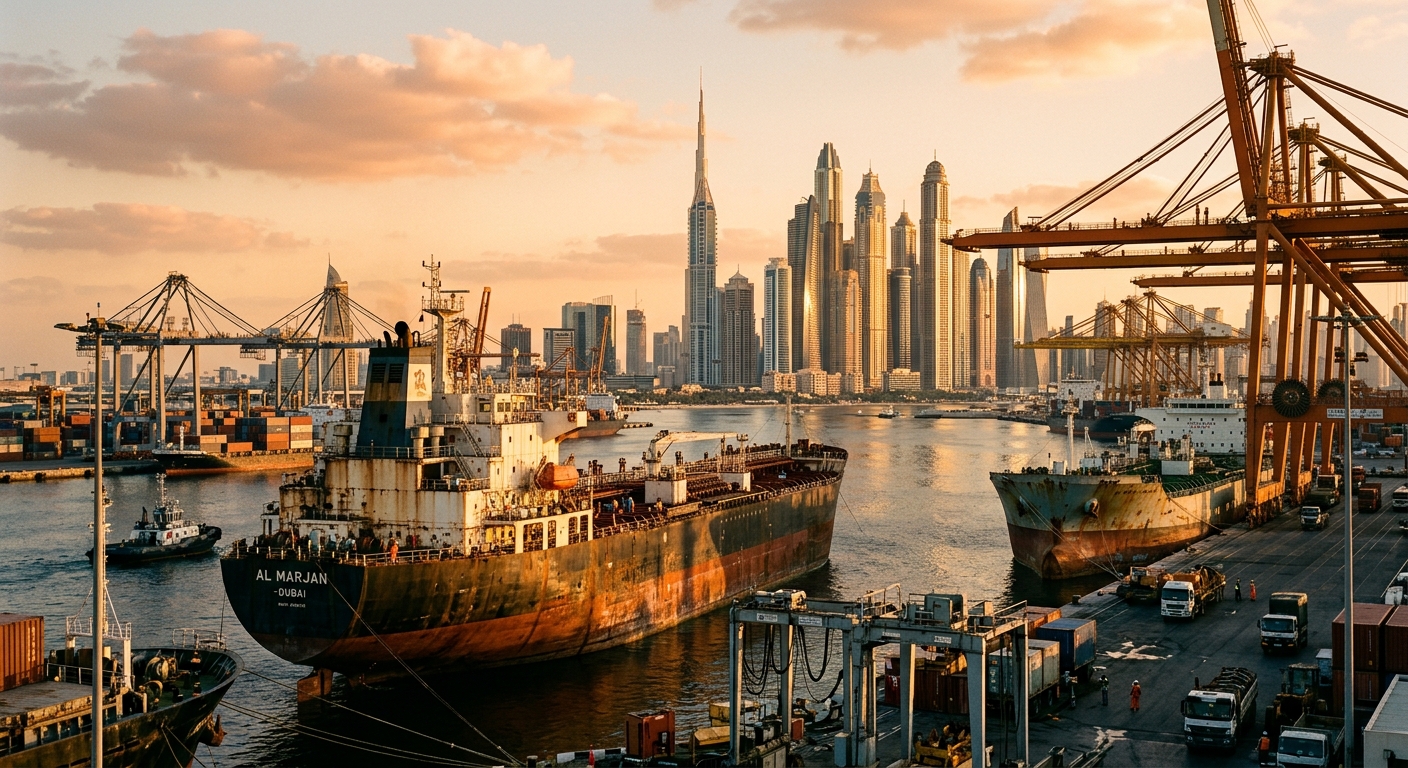
The Treasury’s list of sanctioned assets includes eight crude tankers and one LNG tanker. These vessels are the workhorses of the Shamkhani empire. Many of these ships have long histories of flag-hopping and name-changing. In the dark fleet world, a ship might change its identity three times in a single year to stay one step ahead of the regulators. This constant rebranding is designed to confuse port authorities and satellite tracking services, making it nearly impossible to build a consistent history of the vessel's activities.
The inclusion of an LNG tanker is particularly noteworthy. While the shadow trade in crude oil is well-established, the LNG sector has traditionally been more difficult to penetrate due to the specialized nature of the cargo and the infrastructure required. Sanctioning an LNG vessel suggests that the Shamkhani network was moving into more sophisticated energy products. This represents an escalation in the shadow trade’s capabilities. It indicates that sanctioned regimes are no longer content with just moving crude; they are looking to monetize their natural gas reserves through the same illicit channels.
Operating these vessels is a logistical nightmare that requires a specialized set of skills. The crews often work under precarious conditions, and the ships are frequently older vessels that should have been sent to the scrap yard years ago. Maintenance is often deferred, and safety protocols are treated as optional. This creates a massive environmental risk for the coastal nations along the shadow fleet’s routes. A single spill from a Shamkhani-managed tanker would not only be a disaster for the ocean but would also trigger a complex legal battle over liability and insurance that could take decades to resolve.
“The dark fleet is no longer a collection of rogue actors; it is a parallel global economy with its own banks, its own managers, and its own rules.”
The Russian Synergy
The Shamkhani network was not just an Iranian project; it was a collaborative effort that served Russian interests as well. Since the invasion of Ukraine and the subsequent imposition of Western sanctions on Russian energy, Moscow has been forced to find new ways to get its oil to market. Iran, with its decades of experience in sanctions evasion, was the perfect partner. The two regimes have effectively pooled their resources, sharing tankers, front companies, and financial networks to bypass the G7 price cap and other restrictions.
This synergy has created a formidable challenge for Western enforcement agencies. When a tanker moves Russian oil using an Iranian-managed front company in the UAE, the jurisdictional complexity becomes a maze. The US Treasury’s decision to target the Shamkhani empire is a direct strike at this unholy alliance. It signals that Washington is no longer willing to treat Iranian and Russian sanctions as separate issues. They are now viewed as two branches of the same problem, requiring a unified and aggressive response.
The cooperation between Tehran and Moscow extends beyond just shipping. It involves a deep level of intelligence sharing and technical cooperation. The two regimes have learned from each other's mistakes and successes. Russia has adopted many of the "ghost ship" tactics that Iran pioneered, such as disabling AIS transponders and conducting ship-to-ship transfers in international waters. In return, Russia provides Iran with a larger market for its crude and access to a broader network of sympathetic buyers in Asia. The Shamkhani sanctions are an attempt to break this feedback loop and force both regimes back into economic isolation.
Compliance Risks for Legitimate Operators
For legitimate ship owners and managers, the Shamkhani sanctions represent a massive compliance headache. The use of "clean" front entities means that a perfectly law-abiding company could find itself inadvertently doing business with a sanctioned network. A freight forwarder might book cargo on a vessel managed by a Shamkhani shell company without ever knowing the true owner. By the time the Treasury announces the sanctions, the damage to the legitimate company's reputation and bank account is already done.
This environment requires a level of due diligence that goes far beyond checking a list of names. It requires a deep dive into the corporate structures and historical activities of every partner in the supply chain. Legitimate operators must now act like private investigators, looking for the subtle red flags that indicate a front company. These flags might include a sudden change in ownership, a lack of physical office presence, or a history of operating in high-risk jurisdictions with no clear business rationale.
The financial consequences of a compliance failure are catastrophic. Banks will often freeze all assets associated with a sanctioned entity immediately, leaving legitimate partners with unpaid invoices and stranded cargo. Furthermore, the "contagion" effect means that any company that has done business with a sanctioned entity may find itself under investigation. In the maritime world, where trust and reputation are the primary currencies, being linked to a shadow empire like Shamkhani’s can be a death sentence for a business. It is a high-stakes game where the rules are constantly changing and the penalties are absolute.
What The Numbers Say
The Shamkhani network reportedly managed over $10 billion in annual petroleum sales. With the new sanctions, the US Treasury has effectively frozen hundreds of millions of dollars in liquid assets held in UAE banks. For the 'dark fleet,' which operates on tight margins and relies on quick cash turnover, this sudden loss of liquidity is more damaging than the loss of the ships themselves. It disrupts the entire cycle of procurement, maintenance, and crew payments.
The Looming Shadow of Central Bank Controls
Central banks in the Gulf region are now on high alert. The Shamkhani sanctions have sent a clear message: the US Treasury is watching the flow of dirhams as closely as the flow of dollars. Regional banks, which often serve as the bridge between local trade and the global financial system, are now terrified of being cut off from the US financial system. This fear has created a "chilling effect" across the regional economy. Even companies with no ties to the Shamkhani network are finding it harder to open accounts or process international transfers as banks tighten their internal controls.
This tightening of the financial screws is the most effective weapon in the sanctions arsenal. A ship can be renamed or reflagged, but a frozen bank account is much harder to replace. The Shamkhani network relied on the ability to move money quickly and quietly through UAE-based accounts. Now that those accounts are under the microscope, the network’s operational efficiency will plummet. They will be forced to use even more convoluted and expensive payment methods, such as physical cash transfers or unregulated crypto-assets, which significantly increases their overhead and risk.
The impact also extends to the ship managers and service providers who were not directly sanctioned but who were part of the Shamkhani ecosystem. These firms now face a choice: cut ties immediately and eat the financial loss, or risk being the next target of the Treasury’s wrath. Most are choosing the former. This mass exodus of legitimate service providers will leave the dark fleet even more isolated and reliant on a shrinking pool of low-quality partners. The result is a fleet that is not only financially stressed but also increasingly dangerous to operate. It is a downward spiral that the US Treasury is more than happy to accelerate.
The Geopolitical Fallout
The dismantling of the Shamkhani network is a strategic victory for Western diplomacy, but it also raises the stakes in an already volatile region. For Iran, the loss of this multi-billion dollar revenue stream is a significant blow to its ability to fund its regional proxies and domestic security apparatus. The regime in Tehran has long relied on these shadow networks to maintain a semblance of economic stability in the face of international isolation. When these networks are compromised, the internal pressure on the regime increases, leading to potential shifts in their domestic and foreign policy calculus.
Russia, too, finds itself in an increasingly tight spot. The reliance on Iranian expertise and UAE-based front companies was a key part of Moscow's strategy to weather the storm of Western sanctions. As these channels close, Russia will be forced to look for even more desperate and expensive alternatives. This might include building its own dedicated shadow fleet from scratch or relying on less reliable partners in other parts of the world. Each new hurdle increases the "sanctions tax" on every barrel of Russian oil sold, further depleting the Kremlin’s war chest and limiting its strategic options.
The broader maritime industry must also grapple with the long-term implications of this crackdown. The era of the "unregulated ocean" is rapidly coming to an end. The level of transparency and accountability required to operate in the global energy trade is reaching unprecedented heights. While this is a positive development for environmental safety and international security, it also adds significant costs and complexity to legitimate trade. Ship owners, charterers, and insurers must now invest heavily in the technology and expertise needed to navigate this new landscape. Those who fail to adapt will find themselves increasingly marginalized in a world where "clean" is the only way to stay in business. The Shamkhani saga is just one chapter in a much larger story of how the global maritime industry is being redesigned for a more transparent and law-abiding future. It is a future where the shadows are shrinking, and the light of regulatory scrutiny is brighter than ever.
How Exaqube Helps
Navigating the web of 'clean' front entities and shadow managers requires more than a manual checklist; it requires the deep-learning capabilities of InvoiceSense and QubeSense. InvoiceSense automatically validates tariffs and invoices against known global sanction lists, flagging suspicious billing patterns that often hide the fingerprints of networks like Shamkhani’s. Meanwhile, QubeSense provides an AI-powered search layer across your entire archive of shipping documents, allowing compliance teams to instantly trace the historical ownership and management links of any vessel or entity in their pipeline. For ship managers operating in the Gulf, these tools turn a manual investigative nightmare into a streamlined, automated defense against inadvertent sanctions violations. In an era where a single 'clean' invoice can hide a multi-billion dollar illicit operation, having an AI-driven audit trail is the only way to ensure your business stays on the right side of the law.
The US Treasury’s strike against the Shamkhani network marks a significant escalation in the global effort to drain the shadow economy. While the dark fleet will undoubtedly attempt to reorganize under new names and new jurisdictions, the financial walls are closing in. Legitimate maritime operators must remain vigilant, as the line between legal trade and sanctioned activity becomes thinner and more difficult to spot. The game of cat and mouse in the Persian Gulf is far from over, but the cat just got a much better pair of glasses.
Originally reported by [maritime-executive.com](https://maritime-executive.com/article/shamkhani-sanctions-deal-a-major-blow-to-the-dark-fleet)
Originally published at maritime-executive.com.