

Ghost in the Machine: The Lethal Evolution of Russia’s Shadow Fleet
TL;DR
The shadow fleet has evolved from a mere sanctions-evasion mechanism into a primary source of physical maritime risk and hybrid warfare potential.
Operating without Tier 1 insurance or transparent maintenance schedules, these aging tankers represent a multi-billion dollar environmental liability for every coastline they pass.
Intentional AIS spoofing and "dark" operations are complicating navigation for legitimate commercial traffic in increasingly crowded corridors like the Danish Straits.
The shadow fleet is no longer just a collection of rusty tankers hiding in the margins of global trade; it has become a floating geopolitical minefield. These vessels navigate the world’s most sensitive chokepoints with the transparency of a lead brick and the reliability of a coin flip. As risks widen around Russian waters, the maritime industry is discovering that "out of sight" does not mean "out of range." Global trade now shares the water with a ghost fleet that answers to no regulator and fears no sanction, turning routine voyages into high-stakes gambles.
The Rustbucket Renaissance
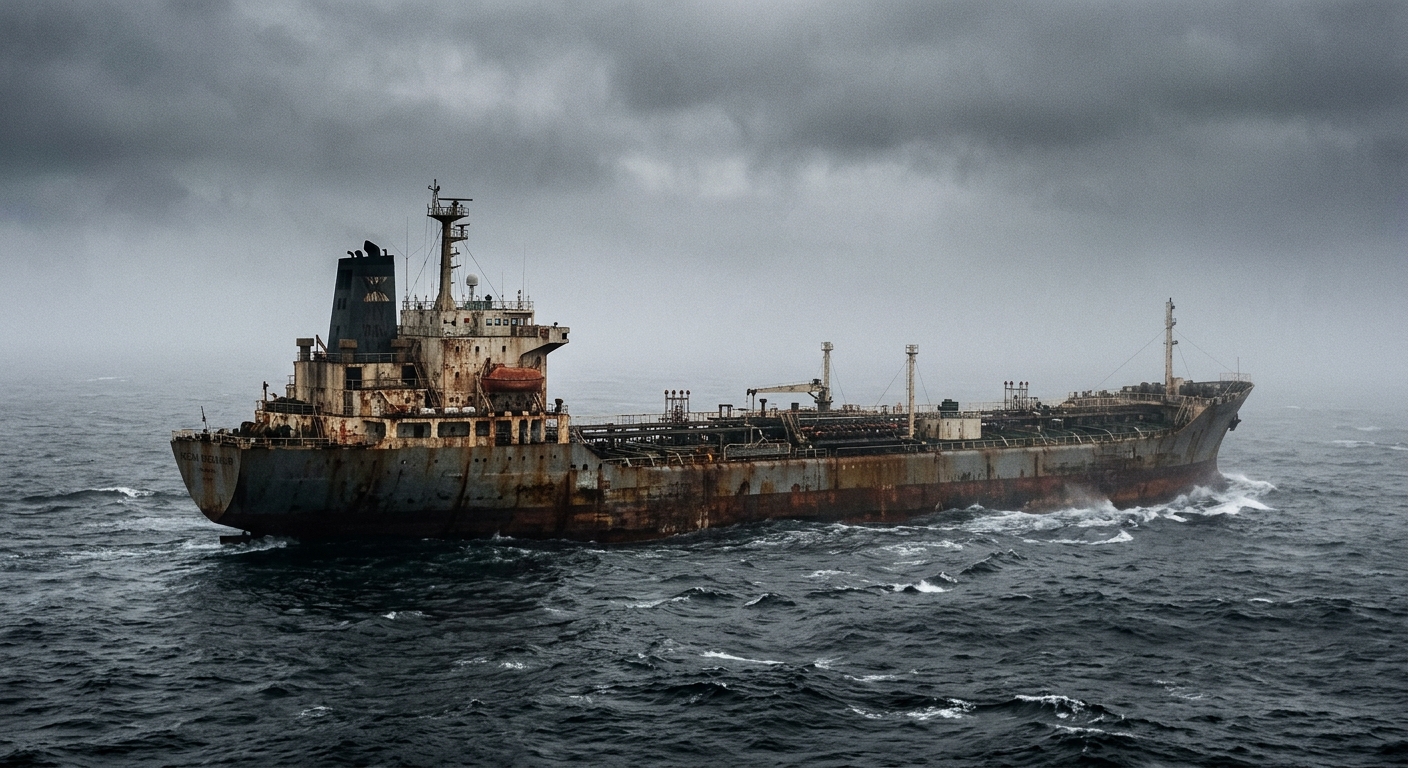
The shadow fleet relies on a fleet of vessels that most reputable owners would have sent to the breakers years ago. These tankers often exceed twenty years of age, a milestone usually marking the end of a ship's economic life. Instead of retirement, these hulls find new life under obscure shell companies registered in jurisdictions where the sun always shines but the regulators never look. They carry millions of barrels of crude through the Baltic and North Seas, often with maintenance records that are either missing or creatively fictionalized.
Standard industry practices dictate that older ships undergo rigorous inspections and frequent dry-docking. The shadow fleet ignores these norms, operating on a shoestring budget that prioritizes cargo volume over hull integrity. This lack of oversight creates a significant structural risk. A single engine failure in a narrow channel like the Danish Straits could lead to a grounding that blocks trade for weeks. The physical condition of these ships is the first link in a chain of escalating maritime hazards.
The crews on these vessels often lack the specialized training required for high-risk maneuvers or emergency response. Operating a twenty-year-old Aframax in heavy seas requires a level of seamanship that "ghost" operators rarely pay for. When technical failures occur, the crew's ability to prevent a catastrophe is limited by both their experience and the available equipment. This human element adds another layer of unpredictability to an already volatile situation.
Insurance? We’ve Heard of It
Legitimate shipping operates within the safety net of the International Group of P&I Clubs. This network provides the multi-billion dollar coverage necessary to handle massive oil spills or catastrophic collisions. The shadow fleet operates outside this system, often claiming coverage from obscure domestic insurers or "sovereign guarantees" from sanctioned nations. These guarantees are often as solid as a wet napkin when a real disaster strikes. If a shadow tanker spills oil off the coast of Sweden, there is no clear path to financial recovery for the cleanup costs.
This lack of insurance isn't just a financial headache; it changes how ships behave on the water. A captain with full P&I coverage follows the rules because the insurer demands it. A captain on a shadow vessel knows that his employer will simply dissolve the shell company if things go wrong. This "moral hazard" encourages risky navigation and the cutting of corners that would be unthinkable in the regulated sector. The absence of a financial safety net makes every shadow vessel a potential fiscal black hole for neighboring states.
The situation forces coastal authorities into a defensive crouch. Navies and coast guards must monitor these vessels more closely than they would a Maersk or Hapag-Lloyd ship. This surveillance consumes resources and increases the chance of a misunderstanding or a physical confrontation. The shadow fleet effectively externalizes its risk, forcing the rest of the world to pay the premium for its continued operation. It is a parasitic relationship that the maritime industry has yet to resolve.
"In the shadow fleet, the only thing more opaque than the ownership is the insurance policy."
Collisions and Cloak-and-Dagger
Automatic Identification System (AIS) spoofing has moved from a niche tactic to a standard operating procedure. Shadow vessels frequently broadcast false locations or simply turn off their transponders to hide their visits to sanctioned ports. This "going dark" creates a massive safety hazard for other mariners who rely on AIS to avoid collisions in low visibility. A 250-meter tanker appearing out of the fog without a digital footprint is the stuff of maritime nightmares. It turns the Baltic Sea into a high-stakes game of blind man’s bluff.
Beyond simple invisibility, some vessels engage in sophisticated location spoofing. They might broadcast coordinates that place them hundreds of miles away from their actual position. This digital deception complicates the work of search and rescue teams and traffic management centers. If a shadow vessel experiences an emergency while spoofing its location, the delay in response could be fatal. The technology designed to make the seas safer is being weaponized to make them more dangerous.
The risk of collision is not theoretical. Several near-misses have been reported in the narrow corridors of the Danish Straits and the English Channel. In these crowded waters, a ship that doesn't follow the rules is a moving obstacle for everyone else. Legitimate captains must now account for the "unpredictable element" on their radar screens. This increased cognitive load on bridge crews is a subtle but real factor in the widening risk profile of global shipping.
The Baltic Pressure Cooker
The Baltic Sea is the primary exit route for Russian oil, and its geography is unforgiving. The Danish Straits are shallow, narrow, and complex to navigate. Traditionally, ships take on a local pilot to ensure safe passage through these treacherous waters. Many shadow fleet vessels are now refusing these pilotage services to avoid scrutiny or save on costs. This decision increases the probability of a grounding or a collision in one of the world’s busiest maritime arteries.
Coastal states like Denmark and Sweden find themselves in a legal quandary. International maritime law, specifically the UN Convention on the Law of the Sea (UNCLOS), guarantees the right of "innocent passage." Stopping or inspecting a ship in international waters is a diplomatic minefield. However, when that ship is a twenty-year-old rustbucket with no insurance and a spoofed AIS, the definition of "innocent" becomes strained. The Baltic has become a laboratory for testing the limits of maritime sovereignty and international law.
The environmental stakes in the Baltic are particularly high because the sea is semi-enclosed and has a slow water exchange. An oil spill here would be far more devastating than a similar spill in the open ocean. The ecosystem would take decades to recover, and the economic impact on tourism and fishing would be catastrophic. The shadow fleet is essentially holding the Baltic environment hostage to maintain the flow of sanctioned oil. It is a game of chicken played with millions of gallons of crude.
The Regulatory Angle
Regulators in the EU and the US are engaged in a permanent game of whack-a-mole. Every time a specific vessel or shell company is sanctioned, three more appear to take its place. The "price cap" mechanism was designed to keep oil flowing while limiting revenue, but it unintentionally fueled the growth of this unregulated fleet. Now, authorities are shifting their focus from the ships themselves to the services that enable them, such as flagging registries and satellite communication providers. It is a slow, bureaucratic battle against a nimble and well-funded adversary.
Regulatory Whack-a-Mole
The administrative agility of the shadow fleet is impressive. A ship can change its name, its flag, and its registered owner in the time it takes to sail from Primorsk to the Mediterranean. Flags of convenience that were once considered obscure have seen their registries swell with Russian-linked tonnage. These registries often lack the resources or the will to enforce international safety standards. For a shadow operator, a flag is not a symbol of national pride; it is a temporary license to operate in the gray.
This constant reshuffling makes enforcement nearly impossible for Western authorities. By the time a vessel is added to a sanctions list, it has often been sold to a "new" company with a different address in Dubai or Hong Kong. The paperwork trail is a labyrinth designed to exhaust the patience of even the most diligent investigator. This administrative smoke screen is just as important to the fleet's survival as the physical tankers themselves. It allows the trade to continue under a veneer of legality that is just thick enough to avoid immediate seizure.
The role of "middlemen" in this ecosystem is also expanding. Ship brokers, bunkering services, and even some port agents have found ways to facilitate shadow trade without technically violating sanctions. They operate in the "gray zones" of international law, where the definitions of "compliance" are flexible. This network of facilitators provides the logistical backbone that keeps the rustbuckets moving. Without this support system, the shadow fleet would grind to a halt within weeks.
The Environmental Time Bomb
If a shadow tanker breaks up, the environmental response will be a logistical nightmare. Standard tankers have clear lines of communication with spill response organizations like ITOPF. Shadow tankers do not. In the event of a spill, who does the coast guard call? Who authorizes the payment for the cleanup vessels? While the lawyers argue over jurisdiction and liability, the oil will continue to spread. The delay inherent in this legal vacuum will significantly worsen the environmental damage.
The types of crude being moved are also a concern. Some Russian grades are heavy and difficult to recover once they hit the water. In the cold waters of the North, oil behaves differently, often sinking or becoming trapped under ice. The shadow fleet’s lack of specialized equipment for such conditions makes a bad situation worse. We are essentially watching a slow-motion train wreck where the cargo is a toxic pollutant and the tracks are the world’s most sensitive coastlines.
Public pressure is mounting on coastal governments to take more aggressive action. There are calls to deny passage to any vessel that cannot prove it has valid, Western-backed insurance. Such a move would be a radical departure from centuries of maritime law and could lead to a direct confrontation with the nations sponsoring the fleet. The choice is between upholding the principle of free navigation and protecting the environment from a predictable catastrophe. It is a choice that no government wants to make.
Geopolitical Collateral
The shadow fleet doesn't exist in a vacuum; its presence affects every legitimate player in the industry. As authorities ramp up inspections to catch shadow operators, the "clean" fleet often gets caught in the dragnet. Port State Control (PSC) inspections are becoming more frequent and more rigorous. For a freight forwarder or a ship manager, this means more delays, more paperwork, and higher operational costs. The shadow fleet is a tax on the efficiency of the entire global supply chain.
There is also the risk of "guilt by association." A legitimate vessel that accidentally interacts with a shadow ship—perhaps through a ship-to-ship (STS) transfer or by sharing a bunkering barge—could find itself blacklisted by Western banks. The complexity of modern maritime logistics makes it difficult to vet every single counterparty in a transaction. This creates a climate of fear and uncertainty that stifles trade and increases the cost of doing business. The "shadow" is long, and it covers more than just the tankers themselves.
Finally, there is the risk of physical conflict. As tensions rise, the shadow fleet could become a target for sabotage or seizure by state actors. This would transform a commercial dispute into a military one, with unpredictable consequences for all shipping in the region. The line between merchant shipping and naval warfare is blurring. For those operating in the Baltic or the Black Sea, the "shadow" is no longer just a metaphor; it is a very real threat to the safety of their crews and their assets.
"The shadow fleet is a tax on the efficiency of the entire global supply chain, forcing legitimate operators to pay for the opacity of others."
The Economic Ripple Effect
The shadow fleet has fundamentally distorted the economics of the tanker market. Normally, a twenty-year-old Aframax is worth its weight in scrap steel. Today, those same vessels command a premium because they are the only ones willing to carry sanctioned cargo. This demand has essentially halted the recycling of older tankers, keeping "bad" tonnage on the water longer than it should be. This artificially tightens the supply of ships in the legitimate market, driving up freight rates for everyone else.
This "sanctions premium" creates a bizarre economic incentive. Owners of aging fleets are rewarded for keeping their ships in questionable condition rather than investing in newer, cleaner technology. It slows down the industry’s decarbonization efforts by making old, inefficient ships highly profitable. The shadow fleet isn't just an environmental and safety risk; it is an economic anchor dragging down the progress of the entire maritime sector. It rewards the past at the expense of the future.
For freight forwarders and cargo owners, this means higher costs and more volatile markets. The shadow fleet operates on its own schedule and its own rules, often disrupting the normal flow of tonnage. When a major shadow operator is suddenly sanctioned, the sudden removal of those ships can cause freight rates to spike overnight. Managing a supply chain in this environment requires a level of visibility and data that many companies simply don't have. The "shadow" makes the market more opaque, more expensive, and more dangerous for everyone involved.
How Exaqube Helps
The chaos and opacity of the shadow fleet are exactly why DataSense and ScheduleSense are essential for modern maritime operations. DataSense provides the real-time analytics and ERP integration needed to vet counterparties and ensure your cargo isn't moving on vessels with questionable histories or missing insurance. Meanwhile, ScheduleSense monitors vessel movements across the globe, flagging the "dark" periods and AIS gaps that characterize shadow fleet behavior before they impact your supply chain. In an industry where the risks are widening and the players are hiding, Exaqube provides the transparency you need to navigate safely. Our AI-powered tools turn fragmented data into a clear strategic advantage, helping you avoid the "shadow" and focus on your bottom line.
The shadow fleet is no longer a temporary workaround for sanctions; it is a permanent fixture of the modern maritime landscape. As the fleet ages and the geopolitical stakes rise, the margin for error is shrinking to zero. Coastal states, regulators, and legitimate shipowners must collaborate on new ways to enforce transparency or prepare for the inevitable fallout of a major incident. The next few years will determine whether the international maritime order can survive this challenge or if the "shadow" will eventually consume the light.
Originally reported by [seatrade-maritime.com](https://www.seatrade-maritime.com/security/shadow-fleet-attacks-widen-maritime-risks-around-russia)
Originally published at seatrade-maritime.com.