

Stuffed to the Gunwales: The Logistics of Spain’s Record-Breaking Maritime Intercept
Spanish authorities intercepted a 'stuffed' vessel off Western Sahara, seizing a record-breaking cocaine haul and exposing a sophisticated mothership strategy.
TL;DR
Spanish authorities intercepted a vessel off Western Sahara carrying a historic volume of cocaine, surpassing previous 10-13 tonne records.
The vessel operated as a "floating warehouse," intending to offload cargo to small boats at sea to bypass port security.
The route utilized Libya as a strategic stopover, highlighting evolving smuggling corridors between Africa and Europe.
Spanish naval units recently turned a routine patrol into a historic logistics disruption off the coast of Western Sahara. They discovered a merchant vessel so "completely stuffed" with cocaine that it challenged the structural imagination of the boarding party. This was not a subtle attempt at concealment; it was an industrial-scale operation masquerading as a standard maritime transit. The interception marks a critical escalation in the ongoing battle between international cartels and European port security.
The High-Seas Intercept off Western Sahara
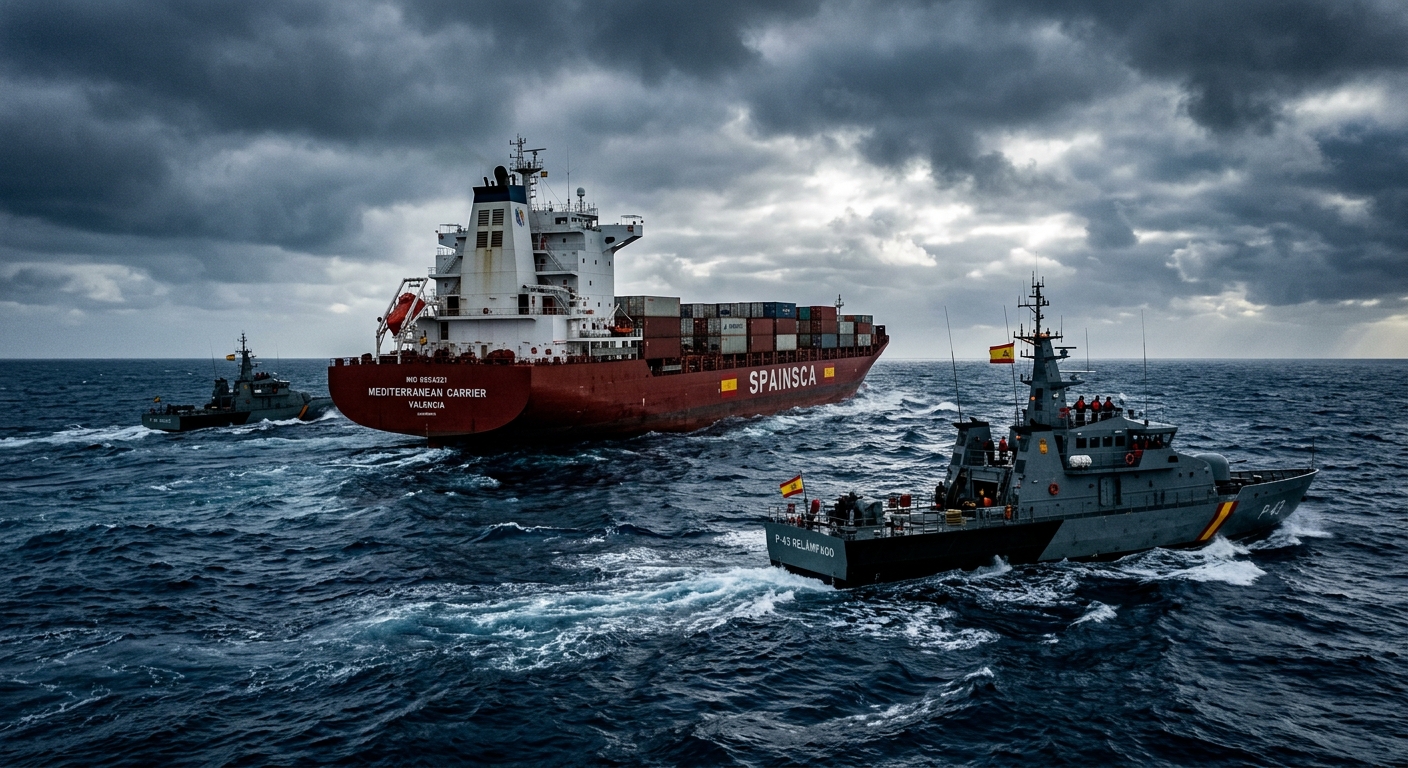
The Spanish Guardia Civil and naval units executed the operation on May 1. They located the vessel in the waters off Western Sahara, a region increasingly becoming a frontline for maritime surveillance. The ship did not present the typical profile of a high-risk vessel, yet the intelligence suggested a massive illicit payload. Authorities redirected the ship to the naval base at Las Palmas de Gran Canaria, where the true scale of the cargo became apparent upon arrival.
The description of the ship as "completely stuffed" suggests a disregard for traditional concealment methods. In many smuggling cases, drugs remain hidden within legitimate cargo or structural voids. This vessel, however, functioned as a dedicated narcotics transport. The sheer volume of bales required a multi-day offloading process, which began immediately under the oversight of Spain’s Audiencia Nacional.
This seizure follows a pattern of increasing cargo volumes in the Atlantic corridor. In early 2024, Spanish authorities intercepted 10 tonnes of cocaine at sea, which set a temporary record. This latest bust appears to exceed that figure significantly, though exact weights remain under seal. The trend points toward a shift in cartel strategy, favoring massive, single-vessel shipments over smaller, diversified loads.
The "Mothership" and Mid-Ocean Logistics
Authorities believe the vessel was not destined for a single port. Instead, the "mothership" strategy likely involved a series of mid-ocean transfers. Small, high-speed boats would meet the larger vessel to offload portions of the cargo. This method disperses the risk across multiple landing points. Bringing such a massive volume into a single European port like Algeciras or Rotterdam is a logistical nightmare that almost guarantees detection by automated scanning systems.
The coordination required for these ship-to-ship transfers is immense. It requires precise timing, encrypted communication, and a fleet of secondary vessels ready to receive the bales. By using multiple small boats, the traffickers can saturate local coastlines, making it nearly impossible for authorities to track every individual landing. This "last mile" logistics challenge is where the criminal enterprise mirrors legitimate supply chain management, albeit with significantly higher stakes.
Libya’s role as a transshipment stop adds another layer of complexity to the route. The North African nation has become a hub for various forms of illicit transit due to its porous borders and political instability. Using Libya allows traffickers to "wash" the vessel’s route, making its final approach to Europe appear less suspicious to maritime patrol units. The geopolitical vacuum in certain Mediterranean regions provides the perfect staging ground for these high-volume operations.
"Offloading such a massive volume in a single port is a logistical suicide mission; the 'mothership' strategy is the only way to move 15 tonnes of cargo without a paper trail."
A Diverse Crew and the Legal Fallout
The 23 crew members currently in detention represent a global cross-section of the maritime workforce. With individuals from the Philippines, the Netherlands, and Angola, the crew composition is typical of the international shipping industry. However, their involvement in a record-breaking narcotics transit raises questions about recruitment and the potential for coercion or high-value payoffs. It is a stark reminder that the human element remains the most significant variable in maritime security.
Spanish law enforcement is now conducting a comprehensive search of the vessel. The case is under a sealed court order from the Audiencia Nacional, Spain's high court that handles major international crimes. This level of judicial oversight indicates that the investigation extends far beyond the ship itself. Authorities are likely looking for digital footprints, communication logs, and financial links that connect the crew to the wider cartel infrastructure.
The legal consequences for the crew are severe. Under Spanish law, large-scale drug trafficking can lead to decades of imprisonment. For the shipping industry, this incident highlights the vulnerability of crews to criminal infiltration. Master mariners and ship owners must now contend with the risk that their vessels could be hijacked or co-opted for illicit purposes without their knowledge, or through the corruption of key personnel. This incident underscores the need for more rigorous background checks and real-time monitoring of crew activities.
The Regulatory Angle
The Audiencia Nacional's involvement signals that this is not a routine drug bust. Spain has tightened its maritime security protocols under EU-wide initiatives to combat organized crime. These regulations often require carriers to provide more granular data on cargo and crew manifests well before a ship enters territorial waters. As the 'mothership' tactic evolves, regulators are looking at ways to monitor ship-to-ship transfers in international waters more effectively, possibly through mandatory AIS (Automatic Identification System) enhancements and satellite surveillance mandates.
Spain’s Strategic Position in Global Narcotics
Spain has long served as the primary gateway for cocaine entering the European market. Its geographic proximity to North Africa and historical ties to South America make it a natural hub for both legal and illegal trade. The Port of Algeciras, in particular, is a focal point for law enforcement. In October 2024, authorities seized 13 tonnes of cocaine hidden in containers there, demonstrating that both containerized and bulk shipping are being exploited at an unprecedented scale.
The shift toward "stuffed" ships intercepted at sea suggests that port security in Algeciras and Valencia is becoming too effective for the cartels' comfort. When scanners and AI-driven risk profiling make containerized smuggling too risky, traffickers revert to older, more direct methods. This "sea-to-shore" transfer bypasses the sophisticated infrastructure of modern ports entirely, relying instead on the vastness of the Atlantic to hide the primary vessel from land-based surveillance.
This cat-and-mouse game has significant implications for freight rates and insurance premiums in the region. As maritime security operations increase in intensity, the cost of operating in these lanes inevitably rises. Ships that deviate from their declared routes or engage in unscheduled stops near high-risk zones like Libya may face increased scrutiny, leading to delays and higher operational costs for legitimate shippers. The industry must prepare for a future where security compliance is as critical as fuel efficiency.
The Logistics of Concealment vs. Volume
In the world of maritime logistics, volume is usually an advantage. For traffickers, however, volume creates a visibility problem. A ship "completely stuffed" with bales of cocaine is an outlier in every sense. It lacks the balance and manifest consistency of a commercial merchant vessel. Detecting these anomalies requires a blend of traditional intelligence and modern data analytics that can flag vessels behaving outside of normal parameters, such as making unscheduled stops in the middle of the Atlantic.
The physical labor involved in moving 15 tonnes of cargo by hand at sea is staggering. Each bale must be hauled from the hold to the deck and then lowered into smaller craft. This process takes hours, if not days, during which the vessel is stationary and vulnerable. The decision to "stuff" a ship suggests a high level of confidence in the mid-sea transfer window or a desperate need to move inventory before a crack-down. It is a high-risk, high-reward strategy that relies on the sheer exhaustion of maritime patrol resources.
From a technical perspective, the weight of such a cargo would affect the vessel's draft and stability. While cocaine is less dense than steel or machinery, 15 tonnes of it—plus the weight of the packaging—creates a measurable change in the ship's profile. Modern port authorities and naval units are increasingly using sensor data to detect these subtle physical discrepancies. When a ship’s displacement does not match its declared manifest, it triggers an immediate red flag for boarding parties.
What The Numbers Say
The scale of this seizure is staggering when compared to standard logistics. Fifteen tonnes of cocaine is roughly equivalent to the weight of a standard 20-foot container (TEU) fully loaded with light consumer goods. However, the street value of this single shipment exceeds the total value of many merchant ships' entire annual cargo. This economic incentive is why traffickers are willing to risk 'stuffing' a vessel; a single successful transit can fund a decade of future operations. In 2024 alone, Spain has already intercepted over 25 tonnes of cocaine at sea, signaling a massive surge in supply.
The Surveillance Challenge and Industry Implications
For the legitimate shipping industry, these incidents create a climate of suspicion. Every merchant vessel operating in the South Atlantic or Mediterranean corridors is now a potential subject of interest for naval patrols. This leads to more frequent boardings, longer wait times at ports, and more stringent documentation requirements. The friction introduced by these security measures is a hidden cost that freight forwarders and port operators must eventually pass on to their customers, further complicating global supply chain economics.
The use of Libya as a transshipment point is particularly concerning for the industry. Libya is not a traditional hub for high-volume container traffic, so any vessel calling there before heading to Europe is immediately flagged by risk-profiling algorithms. This forces legitimate operators to carefully consider their route planning. A "dirty" stop on a vessel's AIS history can lead to days of delays at European ports, even if the cargo is perfectly legal and the crew is beyond reproach. The reputational risk of being associated with these regions is now a primary concern for major carriers.
As traffickers adopt more sophisticated logistics, the maritime industry must respond with better technology. The "mothership" strategy relies on being invisible in a sea of data. To counter this, port operators and shipping lines are turning to AI-driven visibility platforms. These tools can identify abnormal vessel behavior, such as loitering or "going dark" by turning off AIS transponders, which are the hallmarks of a mid-sea transfer operation. The battle for the seas is increasingly being fought in the digital domain, where data is the most valuable weapon.
The Future of Maritime Security
The record-breaking nature of the Spain intercept suggests that the volume of narcotics in transit is not decreasing despite increased enforcement. If anything, the cartels are becoming more ambitious. This means that maritime security will likely become a more integrated part of the global shipping infrastructure. We can expect to see more public-private partnerships where shipping lines share data with naval intelligence to identify high-risk vessels before they reach territorial waters. The era of the "isolated" merchant ship is coming to an end.
Automation will play a key role in this evolution. Drones and autonomous underwater vehicles (AUVs) are already being tested for hull inspections and long-range surveillance. These technologies can perform the dangerous and tedious work of checking for structural anomalies or monitoring "motherships" in remote areas of the ocean. For the shipping industry, the goal is to make these security checks as seamless as possible, minimizing the impact on transit times. The faster a legitimate vessel can prove its innocence, the better for the entire supply chain.
Ultimately, the "stuffed" ship intercepted off Western Sahara is a symptom of a larger logistical war. As long as the economic rewards for smuggling remain high, traffickers will continue to innovate. The industry’s best defense is a combination of robust data transparency and advanced analytics. By making the maritime supply chain more visible, we make it harder for illicit actors to hide in plain sight. Security is no longer just a police matter; it is a fundamental pillar of modern maritime operations.
How Exaqube Helps
The logistical nightmare of a 'stuffed' vessel is exactly why DataSense and QubeSense are becoming essential tools for the industry. DataSense provides real-time visibility into vessel movements and performance, allowing operators to flag anomalies like unscheduled stops or draft discrepancies that might indicate a mid-sea transfer. Meanwhile, QubeSense uses AI to search through thousands of shipping documents and manifests, identifying the subtle linguistic and data-driven red flags that often precede a major security incident. For port operators and carriers, the ability to cross-reference real-time ship behavior with historical document data is the difference between a secure transit and a record-breaking disaster. Exaqube ensures that your data works as hard as your security team to keep the supply chain clean.
As the Spanish authorities begin the arduous process of cataloging this record-breaking haul, the shipping industry must brace for a new era of heightened scrutiny. The "mothership" tactic is a direct response to improved port security, and its success relies on exploiting the gaps in high-seas surveillance. Moving forward, the integration of AI-driven data analytics and international naval cooperation will be the only way to effectively monitor these vast maritime corridors. The "stuffed" ship off Western Sahara may be the largest bust yet, but it certainly won't be the last attempt to turn the ocean into a warehouse.
Originally reported by [maritime-executive.com](https://maritime-executive.com/article/spanish-intercept-ship-completely-stuffed-with-record-cocaine-load)
Originally published at maritime-executive.com.