

The $2 Billion Pipe Dream: Why Iran’s Jask Terminal is Running Dry
Iran's $2 billion Jask terminal was meant to bypass the Strait of Hormuz. Instead, political haste and technical failures have left it a dormant strategic asset
TL;DR
Iran’s $2 billion investment in the Jask terminal aimed to bypass the Strait of Hormuz but has largely resulted in a dormant strategic asset.
Political pressure led to a premature 2021 inauguration, causing technical damage to the 685-mile pipeline before it was fully operational.
Saudi Arabia and the UAE are successfully expanding their own bypass routes, leaving Iran’s maritime "Plan B" struggling to compete.
Iran spent $2 billion to build an escape hatch it cannot seem to use. The Jask oil terminal was supposed to render the Strait of Hormuz irrelevant for Iranian crude exports, providing a strategic outlet on the Gulf of Oman. Instead, the 685-mile pipeline stands as a monument to political impatience and engineering shortcuts. Today, the facility remains a quiet observer of the very shipping lanes it was designed to circumvent, proving that in maritime logistics, a finished pipe is not the same as a functional one.
The Geopolitical Choke Point
The Strait of Hormuz remains the most significant oil transit point globally. Roughly 20% of the world’s liquid petroleum passes through this narrow waterway daily. For Iran, this geography is both a shield and a cage. While Tehran can threaten to close the strait to pressure international rivals, it remains equally hostage to the same narrow passage for its own survival.
Ninety percent of Iranian oil exports traditionally flow through the Kharg Island terminal, located deep within the Persian Gulf. This concentration creates a massive single point of failure. A blockade or a targeted strike on Kharg could effectively decapitate the Iranian economy overnight. The Jask project was the theoretical solution to this existential dread, moving the export point past the Musandam Peninsula to the open waters of the Gulf of Oman.
Moving exports to Jask would have shortened the journey for tankers by several days. It would have also allowed Iran to load vessels outside the immediate surveillance of Western naval forces stationed in the Gulf. However, the strategic logic of the project was eventually undermined by the rush to claim a political victory before the infrastructure was actually ready to receive a single drop of crude.
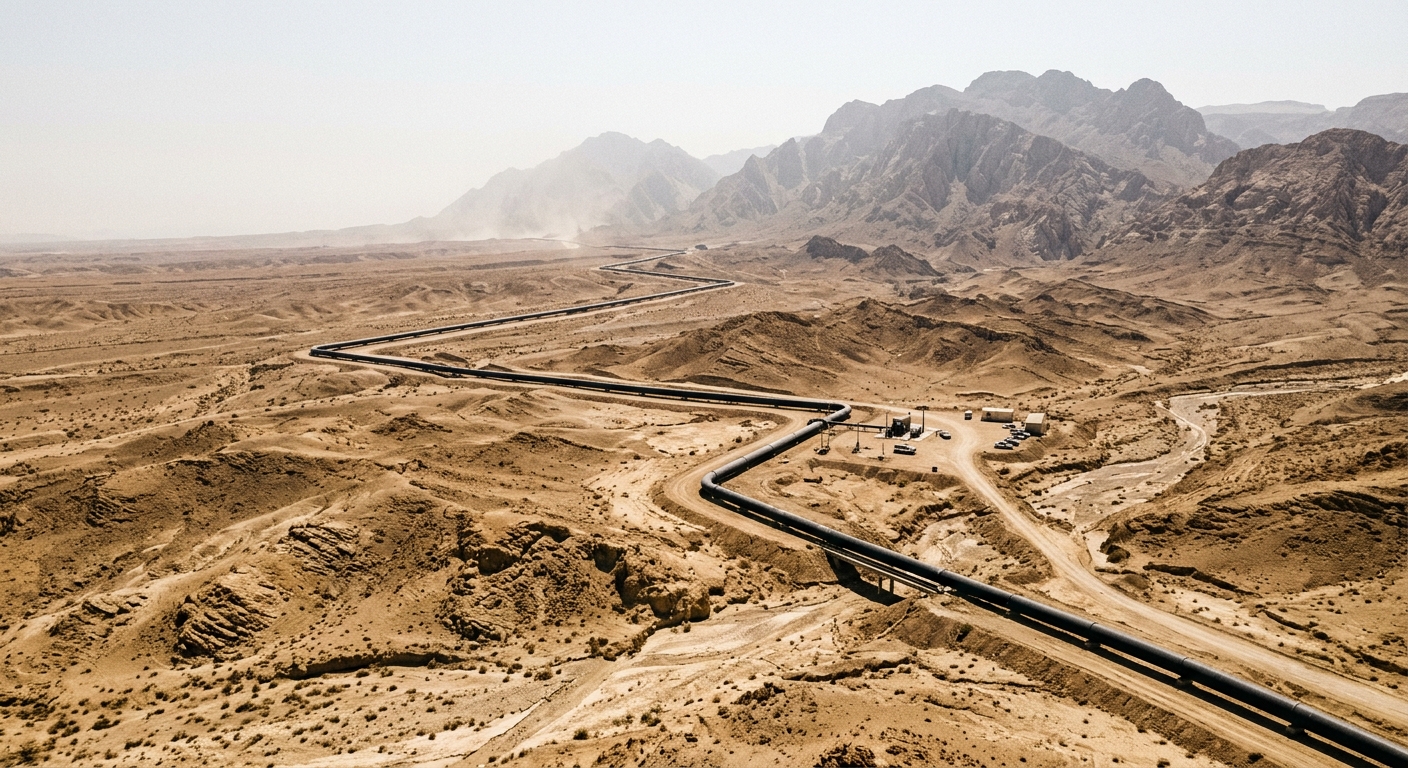
The Goreh-Jask pipeline was an engineering project of staggering proportions. Spanning 685 miles across rugged terrain, the 42-inch diameter pipe was designed to transport 1 million barrels of crude per day. Construction required nearly 400,000 tons of specialized steel, much of which Iran had to produce domestically due to ongoing international sanctions.
The route traverses the Bushehr, Fars, and Hormozgan provinces, terminating at Kooh Mobarak near the port of Jask. Engineers had to navigate extreme temperatures and seismically active zones to lay the heavy-gauge steel. The project also included the construction of five massive pumping stations and two pigging stations to maintain flow and monitor the pipeline's internal health.
On paper, the facility was a masterpiece of domestic resilience. It promised to transform the sleepy fishing village of Jask into a global energy hub. The plan included twenty storage tanks, each capable of holding 500,000 barrels, alongside three Single Buoy Moorings (SBMs) for offshore loading. Yet, the gap between engineering blueprints and operational reality began to widen as political timelines took precedence over technical safety protocols.
In July 2021, President Hassan Rouhani was preparing to leave office. He needed a legacy project to burnish his final days, and Jask was the perfect candidate for a grand finale. Despite warnings from technical experts and members of parliament, Rouhani ordered the terminal into service. The ribbon was cut, the cameras rolled, and the oil began to flow—briefly.
The decision to bypass final pressure testing proved catastrophic. Bringing the pipeline into service before completion reportedly caused internal damage and structural stress that plagued the system for months. Critics in the Iranian parliament later lambasted the administration for "damaging the pipeline" in a desperate bid for a photo opportunity.
This premature launch effectively stalled the project’s momentum. Instead of a steady stream of exports, the terminal became a site of constant repairs and troubleshooting. The 1 million bpd target remained a fantasy as operators struggled to maintain consistent pressure and flow. What was meant to be a strategic triumph quickly devolved into a case study of how political ego can derail critical infrastructure.
"The decision to bypass final pressure testing proved catastrophic, turning a strategic triumph into a case study of political ego."
The Kharg Island Vulnerability
Kharg Island has served as the heartbeat of Iranian oil for decades. During the Iran-Iraq War in the 1980s, it was the primary target of Iraqi airstrikes during the "Tanker War." The terminal’s vulnerability is legendary, yet it continues to handle the vast majority of Iran’s output. This reliance creates a strategic fragility that Tehran has desperately sought to mitigate.
The island sits 15 miles off the coast and is accessible only through the narrow corridors of the Persian Gulf. Any disruption in the Strait of Hormuz—whether through military conflict or accidental blockage—immediately traps the oil stored at Kharg. Jask, by contrast, sits on the open sea, offering a direct path to the Arabian Sea and the Indian Ocean beyond.
By bypassing the strait, Iran hoped to gain a significant tactical advantage in sanction-breaking. Tankers loading at Jask could head east immediately, blending into international shipping lanes without the scrutiny of the naval patrols that monitor the Hormuz bottleneck. This "dark fleet" potential was a primary driver for the $2 billion investment, yet the terminal’s inability to reach full capacity has left this strategy in limbo.
Regional Rivals and the Pipeline Arms Race
Iran is not the only player looking for an exit strategy from the Persian Gulf. Saudi Arabia and the United Arab Emirates (UAE) have invested billions in their own bypass routes. The UAE’s Habshan-Fujairah pipeline already transports a significant portion of its crude to the port of Fujairah, located safely outside the Strait of Hormuz. This infrastructure provides Abu Dhabi with a critical insurance policy against maritime disruption.
Saudi Arabia operates the massive East-West Pipeline, which can move up to 5 million barrels per day from its eastern oil fields to the Red Sea port of Yanbu. Recent reports suggest Riyadh is considering even more ambitious projects. Speculation in Saudi media points to a potential connection between the Shaybah oilfield and the Omani terminal at Ras Markaz on the Arabian Sea. This would create a direct outlet to the Indian Ocean that avoids both the Strait of Hormuz and the Bab el-Mandeb.
These regional competitors have largely succeeded where Iran has stumbled. Their pipelines are not just operational; they are integrated into a broader logistical network that includes massive storage facilities and modern refining centers. While Iran struggles with a single 42-inch pipe, its neighbors are building a redundant energy highway that effectively neutralizes the threat of a Hormuz closure for their own economies. This shifting infrastructure landscape is fundamentally altering the power dynamics of the Middle East.
The "Dark Fleet" and Sanctions Evasion
The location of the Jask terminal was chosen with more than just geography in mind. By moving the loading point outside the Persian Gulf, Iran hoped to make its "dark fleet" operations more efficient. Tankers carrying sanctioned Iranian crude often engage in ship-to-ship (STS) transfers or "spoofing" their AIS locations to hide their origin. Loading at Jask would have simplified this process significantly by reducing the time spent in the heavily monitored waters of the Gulf.
The terminal was designed to utilize three Single Buoy Moorings (SBMs) located offshore. These floating platforms allow Very Large Crude Carriers (VLCCs) to moor and load without needing a deep-water dock. Because the SBMs are located in the open sea, tankers can approach and depart with minimal pilotage, making it easier to slip away into the vast expanse of the Indian Ocean unnoticed by satellite surveillance or naval patrols. This tactical advantage was a key component of Iran’s strategy to maintain its oil revenue despite international pressure.
However, the lack of sufficient storage at the Jask site has crippled this advantage. A terminal without massive tank farms is essentially a gas station with no reservoir. Without the ability to store crude locally, the pipeline must pump directly into waiting tankers. This creates a logistical bottleneck where any delay in tanker arrivals—or any technical glitch in the pipeline—brings the entire export operation to a grinding halt. The strategic "escape hatch" has become a logistical trap.
The Tech Angle: Why Storage Matters
In oil logistics, storage is the buffer that absorbs the shocks of supply and demand. Without the planned 10-million-barrel storage facility at Jask, the entire 685-mile pipeline is vulnerable to any disruption at the loading point. If a tanker is delayed by weather or technical issues, the pipeline has nowhere to put the oil, forcing a complete shutdown of the flow from the Goreh collection point. This lack of resilience transforms a $2 billion asset into a brittle, high-risk operation.
The Maintenance Nightmare
Building a pipeline is one thing; maintaining it under sanctions is another. The Jask project has been plagued by a lack of access to high-end Western components, particularly for the pumping stations and the SBM systems. Iranian engineers have had to rely on domestic substitutes or Chinese components, which have not always performed to the required specifications for high-pressure crude transport. This reliance on non-standard parts has created a patchwork system that is difficult to manage and even harder to repair.
Corrosion is a constant threat in the salty, humid environment of the Gulf of Oman. Without regular maintenance and advanced pigging technology, the 685-mile pipe is at risk of internal degradation that could lead to leaks or catastrophic failure. The "premature" opening in 2021 likely introduced air and moisture into the system, accelerating these issues before the terminal was even fully operational. The long-term integrity of the steel is now a major concern for the operators at Kooh Mobarak.
Furthermore, the SBMs themselves require sophisticated underwater infrastructure and regular diving inspections to ensure safe loading operations. In a sanctioned environment where spare parts are difficult to come by, keeping these offshore loading points functional is a Herculean task. The result is a system that operates at a fraction of its design capacity, with long periods of downtime that negate the very efficiency the project was supposed to provide. Iran’s strategic bypass is currently more of a maintenance sinkhole than a revenue stream.
The Economic Fallout and Future Outlook
The $2 billion price tag of the Jask project represents a massive opportunity cost for an economy already under severe strain. That capital could have been used to upgrade existing refineries or invest in renewable energy projects that are less vulnerable to international sanctions. Instead, it is locked in a project that currently serves more as a political talking point than a functional piece of energy infrastructure. The return on investment for the Iranian state remains negligible as long as the terminal remains underutilized.
Looking ahead, the success of Jask depends on two factors: technical completion and geopolitical shifts. If Iran can finally finish the storage tanks and stabilize the pipeline pressure, the terminal could eventually fulfill its promise as a strategic alternative to Kharg Island. However, as the global energy transition accelerates and regional rivals solidify their own bypass routes, the window of opportunity for Jask to become a major hub is rapidly closing. The longer the project remains in its current state, the more likely it is to become a relic of a previous era’s energy strategy.
For the maritime industry, the Jask saga is a reminder that infrastructure is only as good as the political stability and technical rigor behind it. While the world watches the Strait of Hormuz for signs of tension, the real story of Iranian energy may be found in the quiet, underutilized pipes of Kooh Mobarak. The "squandered investment" label will stick until the first million-barrel day becomes a reality rather than a press release. The maritime world remains skeptical, waiting for the flow of oil to match the flow of rhetoric.
How Exaqube Helps
The uncertainty surrounding the Jask terminal’s operations is exactly why DataSense and ScheduleSense are critical for modern maritime logistics. ScheduleSense provides real-time tracking of vessel movements, allowing operators to see exactly which tankers are calling at Jask versus Kharg Island, cutting through the fog of regional shipping maneuvers. Meanwhile, DataSense integrates disparate data sources to provide a clear picture of global crude flows, helping freight forwarders and analysts detect shifts in Iranian export strategy before they impact market rates. In an environment where political theater often masks technical failure, having an objective, AI-driven view of the water is the only way to manage risk effectively. For professionals navigating the volatile energy lanes of the Middle East, these tools turn speculation into actionable intelligence.
The Jask oil terminal remains a potent symbol of Iran’s strategic ambition and its operational limitations. While the dream of bypassing the Strait of Hormuz is technically sound, the execution of the project has left it as a $2 billion insurance policy with a lapsed premium. Whether the terminal eventually becomes a bustling export hub or remains a desert monument to political haste will depend on Tehran’s ability to prioritize engineering over optics. For now, the world’s oil tankers continue to navigate the narrow waters of the Gulf, largely ignoring the empty moorings of Kooh Mobarak.
Originally reported by [maritime-executive.com](https://maritime-executive.com/editorials/iran-s-jask-oil-terminal-a-squandered-2-billion-investment)
Originally published at maritime-executive.com.