

The French Exception: Why CMA CGM is Sending its Largest LNG Giant Through the Suez
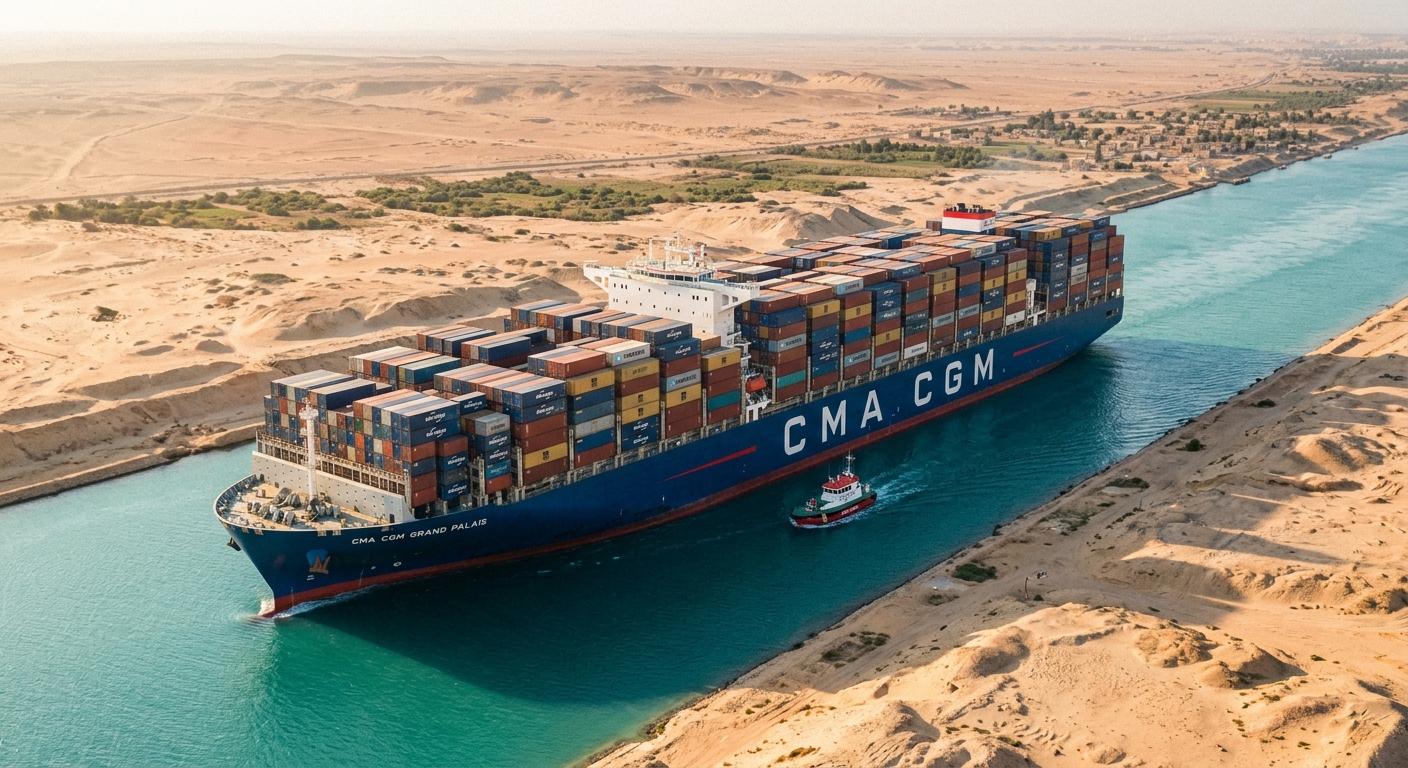
CMA CGM defies the industry-wide Red Sea detour, routing its new 23,876 TEU LNG-fueled flagship through the Suez Canal as a bold strategic statement.
TL;DR
CMA CGM continues to defy the industry-wide Red Sea detour, routing its brand-new 23,876 TEU flagship through the Suez Canal.
The transit of the CMA CGM Grand Palais underscores a major strategic rift between the French carrier and rivals like Maersk and Hapag-Lloyd.
While the Suez Canal Authority uses the transit to signal regional stability, the reality remains a high-stakes calculation of insurance premiums versus fuel savings.
While most of the world's shipping giants are busy taking the scenic—and expensive—route around the Cape of Good Hope, CMA CGM just sent a 400-meter statement of intent through the Suez Canal. The CMA CGM Grand Palais, a behemoth capable of carrying nearly 24,000 containers, recently completed its transit of the Bab al-Mandab Strait and the Suez waterway. This isn't just a maiden voyage; it is a calculated gamble on regional stability that sets the French carrier apart from its more risk-averse peers. In an industry where 'safety first' usually means 'follow the leader,' CMA CGM is increasingly comfortable standing alone at the helm.
The CMA CGM Grand Palais isn't just large; it is the largest LNG-fueled containership ever built. Measuring 400 meters in length and 61 meters in beam, the vessel is a product of the China State Shipbuilding Corporation. It represents the latest evolution in mega-ship design, where massive capacity meets a more sustainable fuel profile. For an industry under pressure to decarbonize, this vessel serves as a floating proof-of-concept for the viability of Liquefied Natural Gas (LNG) on a massive scale.
The deadweight tonnage of 220,923 tons allows for a massive payload, which is essential for the high-volume Asia-Mediterranean trade lanes. Its dual-fuel engines are designed to significantly reduce sulfur and nitrogen oxide emissions compared to traditional heavy fuel oil. For CMA CGM, this ship is the crown jewel of their fleet renewal strategy, proving that environmental targets do not necessarily require a reduction in operational scale.
Delivery of the vessel occurred only six weeks ago, making this transit a critical component of its maiden voyage. After departing from Chinese ports on March 26, the ship called at ports in Vietnam and Singapore before beginning its trek across the Indian Ocean. While most of its contemporaries would have turned south toward the Cape of Good Hope, the Grand Palais maintained its course for the Suez, signaling a distinct operational philosophy from its owner.
The maritime world is currently split into two camps: those who detour and those who dare. Maersk and Hapag-Lloyd, who recently solidified their partnership through the Gemini Cooperation, have largely abandoned the Red Sea route until security guarantees improve significantly. They cite the persistent threat of drone and missile attacks as an unacceptable risk to crew safety and cargo integrity. For these carriers, the 4,000-mile detour around Africa is a necessary, if expensive, insurance policy.
CMA CGM has maintained a much more consistent presence in the Suez Canal throughout the current crisis. This divergence in strategy isn't merely about a higher tolerance for risk; it reflects a different calculation of geopolitical protection. The French Navy has been notably active in providing escorts for French-linked vessels in the region. This "national interest" umbrella provides a layer of security that other carriers, often operating under various flags of convenience without a dedicated naval protector, simply cannot access.
This strategic split creates a fascinating competitive dynamic in the Asia-Europe trade. By utilizing the Suez Canal, CMA CGM can shave approximately 10 to 14 days off a round-trip voyage compared to the Cape of Good Hope route. In the high-stakes, low-margin world of ocean freight, two weeks of time and fuel savings represent a massive operational advantage. However, the rest of the industry remains skeptical, viewing the Suez Canal Authority’s claims of "renewed stability" with a healthy dose of caution.
For the Suez Canal Authority (SCA), the transit of the Grand Palais is more than just another toll payment; it is a vital piece of propaganda. SCA Chairman Osama Rabie was quick to highlight the transit as evidence of "renewed safety and stability" in the region. With canal revenues reportedly dropping by nearly 50% since the start of the Red Sea crisis, Egypt is understandably desperate to convince the world that the waterway remains a viable and safe shortcut for global trade.
The SCA’s narrative faces a steep uphill battle against the cold reality of maritime insurance premiums. While CMA CGM remains a loyal and high-profile customer, the sheer volume of tonnage that has migrated to the Cape of Good Hope route is staggering. The loss of transit fees is a direct blow to Egypt’s national treasury, which relies on the canal as a primary source of foreign currency. Every mega-ship that chooses the Suez is a PR victory for Cairo, but a handful of transits cannot offset the systemic shift in global routing.
There is also the uncomfortable reality of the Bab al-Mandab Strait. The SCA has no jurisdiction or control over the southern Red Sea, yet their entire business model depends on the safety of that narrow passage. By praising CMA CGM’s "long partnership," Rabie is attempting to project a sense of normalcy that the rest of the industry doesn't yet feel. It remains to be seen if other carriers will be moved by these appeals or if they will continue to prioritize the safety of their crews over the efficiency of the canal.
"The Suez Canal Authority is currently in the business of selling confidence, but the market is still buying insurance."
The Grand Palais is currently deployed on the Mediterranean Club Express (MEX) route, a service that acts as a critical artery for trade between East Asia and the Mediterranean basin. By calling at Malta, the ship serves as a central hub for transshipment across Southern Europe and North Africa. The fundamental logic of this route is built on the Suez shortcut; without it, the transit times to Marseille or Barcelona become significantly less competitive, potentially driving cargo toward Northern European ports that are better served by the Cape of Good Hope route.
For CMA CGM, the MEX service is a flagship offering that requires the highest levels of reliability. The decision to keep the Grand Palais on this route, via the Suez, suggests that the carrier is prioritizing its Mediterranean customer base. These shippers often operate on tighter margins and leaner inventories than their North European counterparts. For a manufacturer in Southern France waiting for components from Shenzhen, a 14-day delay is not just a logistical hiccup—it is a production-halting event. By sticking to the Suez, CMA CGM is offering a "premium" speed that its competitors currently cannot match.
The ship's itinerary is a testament to the scale of modern globalization: it called at six Chinese ports, Vietnam, and Singapore before beginning its Indian Ocean transit. After discharging cargo in Malta, France, and Spain, the vessel will turn around and repeat the process. The Suez Canal Authority has already noted that the ship is expected to transit the canal again at the end of the month on its return leg. Maintaining this predictable "shuttle" service through a high-tension zone requires an immense amount of operational coordination and a very specific risk-mitigation strategy that likely involves close communication with naval authorities.
The Regulatory Angle
The International Maritime Organization’s (IMO) Carbon Intensity Indicator (CII) ratings are making the Suez detour even more painful for carriers. A ship’s rating is calculated based on its carbon emissions per cargo-carrying capacity and distance traveled. When a vessel is forced to take the 4,000-mile detour around Africa, its fuel consumption spikes, potentially dragging down its CII rating from an 'A' or 'B' to a 'D' or 'E'. For modern vessels like the Grand Palais, staying on the Suez route is essential for maintaining the high environmental ratings that regulators and investors now demand.
There is a certain environmental irony in the current maritime crisis. The CMA CGM Grand Palais is a marvel of green technology, designed to minimize its carbon footprint through the use of LNG. However, if such a vessel were forced to take the long route around Africa, the extra 4,000 miles of travel would effectively negate much of the carbon savings achieved by the cleaner fuel. For a carrier committed to net-zero targets, the Suez Canal is not just a shortcut for time; it is a shortcut for emissions.
This highlights a growing tension in the industry between security and sustainability. Carriers are investing billions in dual-fuel vessels and green methanol, yet geopolitical instability is forcing them into the least efficient routes possible. The detour around the Cape of Good Hope adds roughly 1,000 tons of fuel consumption per round trip for a vessel of this size. For a fleet the size of CMA CGM’s, those numbers add up to a significant environmental—and financial—setback. The "greenest" ship in the world still looks like a polluter if it has to sail half-way around the globe to avoid a conflict zone.
By successfully navigating the Suez, the Grand Palais is achieving its true design potential. It is delivering nearly 24,000 TEU of cargo with the lowest possible emissions profile per container mile. This "green efficiency" is a major selling point for CMA CGM’s corporate clients, many of whom are under pressure to report lower Scope 3 emissions. In this context, the Suez Canal is an essential piece of green infrastructure that the industry cannot afford to lose, regardless of the security challenges.
The decision to use the Suez Canal is ultimately a financial calculation. While the detour around Africa increases fuel costs and charter hire, the Suez route comes with its own set of "war risk" insurance premiums. These premiums have fluctuated wildly since late 2023, at times reaching as high as 1% of the ship's total value for a single transit. For a brand-new, $250 million vessel like the Grand Palais, that single-trip insurance bill could be upwards of $2.5 million—a staggering sum for a few days of sailing.
CMA CGM must weigh these insurance costs against the "Suez Canal Surcharges" they pass on to shippers. Most carriers have introduced various surcharges to cover the extra costs of either the detour or the high-risk transit. The challenge for freight forwarders and logistics managers is keeping track of these rapidly changing fees. When one carrier detours and another transits, the price disparity between two "Asia-Europe" bookings can become massive, leading to billing disputes and a general lack of price transparency in the market.
Furthermore, the Suez Canal Authority is in a delicate balancing act regarding its transit fees. If they lower fees too much, they lose vital national revenue; if they keep them high, they risk driving even more traffic to the Cape of Good Hope. The successful passage of the Grand Palais suggests that for ultra-large vessels, the sheer scale of the cargo still makes the Suez fees and insurance premiums palatable, provided the carrier has the risk appetite to match. For the time being, CMA CGM appears to be the only major player willing to make that bet on a consistent basis.
"In the Red Sea, the most expensive container is the one that doesn't arrive."
Behind the headlines of TEU capacity and LNG fuel lies the human element: the crew. Navigating a 400-meter vessel through a high-tension zone like the Bab al-Mandab is a stressful endeavor for any seafarer. While the Suez Canal Authority talks about "stability," the reality on the bridge is one of heightened alert, 24-hour watches, and the constant monitoring of radar for unconventional threats. The sheer size of the Grand Palais makes it an impossible target to miss, increasing the psychological pressure on those responsible for its safe passage.
Seafarers' unions have been increasingly vocal about the risks involved in Red Sea transits. Many have negotiated "right to refuse" clauses, allowing sailors to opt out of voyages that enter designated conflict zones without fear of losing their jobs. CMA CGM’s ability to maintain these routes depends heavily on the morale and cooperation of its crew. While the presence of French naval escorts provides a physical deterrent, the underlying tension of sailing through a region where merchant ships have been targeted remains a significant operational hurdle.
As the Grand Palais heads toward its first European port of call in Malta, its crew can likely breathe a sigh of relief—at least until the return leg at the end of the month. The industry’s reliance on a small pool of highly skilled mariners means that any major incident involving a mega-ship could have repercussions far beyond a single lost vessel. It could lead to a widespread labor refusal to sail the route, effectively closing the Suez Canal to commercial traffic regardless of the geopolitical or economic incentives to keep it open.
The Grand Palais is just the latest in a steady stream of ultra-large container vessels (ULCVs) emerging from Chinese shipyards. The China State Shipbuilding Corporation (CSSC) has become the dominant force in this sector, churning out 24,000 TEU giants for carriers like CMA CGM, MSC, and Evergreen. These ships are built for a world of predictable, high-volume trade, where the "economies of scale" argument trumps almost every other consideration. They are the physical manifestations of a globalized economy that assumes open seas and stable transit points.
However, the current crisis is testing the limits of that "bigger is better" philosophy. A 24,000 TEU ship is only truly efficient if it is full and if it can utilize the shortest possible route. When these giants are forced to take the long detour around the Cape of Good Hope, the cost of operating them—and the complexity of managing their schedules—skyrockets. Moreover, the concentration of so much cargo on a single hull increases the financial stakes of any potential delay or incident. We are witnessing a paradox where ships are becoming more technologically advanced and efficient, while the global trade routes they rely on are becoming more fragmented and volatile.
Looking ahead, the success of the Grand Palais on the Mediterranean Club Express route will be a bellwether for the industry. If CMA CGM can consistently and safely navigate the Suez, it may eventually tempt its rivals back to the waterway, especially as the cost of the African detour continues to mount. But for the moment, the "French Exception" remains a lonely strategy. The giant ship is a monument to what is possible in modern maritime engineering, but its perilous route is a stark reminder of the geopolitical fragility that no amount of engineering can fully overcome.
How Exaqube Helps
The strategic divide between carriers like CMA CGM and Maersk creates a significant challenge for logistics managers trying to predict arrival times and manage costs. This is exactly where ScheduleSense provides much-needed clarity, tracking real-time vessel movements and instantly flagging when a ship like the Grand Palais chooses the Suez over the Cape, allowing you to update your downstream supply chain in minutes rather than days. Simultaneously, the 'Suez Surcharges' and fluctuating war-risk insurance fees mentioned above often lead to complex billing discrepancies. InvoiceSense automates the validation of these volatile tariffs, ensuring that a carrier's unique routing strategy doesn't result in an unexpected and costly exception on your company's balance sheet.
As the CMA CGM Grand Palais completes its maiden transit, the maritime industry remains at a crossroads. While the Suez Canal Authority is eager to declare a return to normalcy, the continued absence of other major carriers suggests that the Red Sea remains a contested and unpredictable space. Whether CMA CGM’s bold strategy becomes the new industry standard or remains a risky outlier will depend entirely on the security developments of the coming months. For now, the world’s largest LNG-fueled ship continues its journey, a blue-hulled symbol of a global trade system that is as resilient as it is vulnerable.
Originally reported by [maritime-executive.com](https://maritime-executive.com/article/cma-cgm-routes-new-giant-containership-through-the-suez-canal)
Originally published at maritime-executive.com.