

The 8-Million-Ton Head Start: China’s Green Fuel Machine Shifts into High Gear
TL;DR
China has reached an 8-million-ton production capacity for green fuels, positioning itself as the primary supplier for the shipping industry’s net-zero transition.
Green hydrogen capacity has surged to 1.1 million tons, with operational projects doubling in 2024 as the 2022 national hydrogen policy yields results.
The massive scale-up leverages renewable energy surpluses and aggressive electrolyzer deployment to bridge the gap between experimental pilots and commercial bunkering.
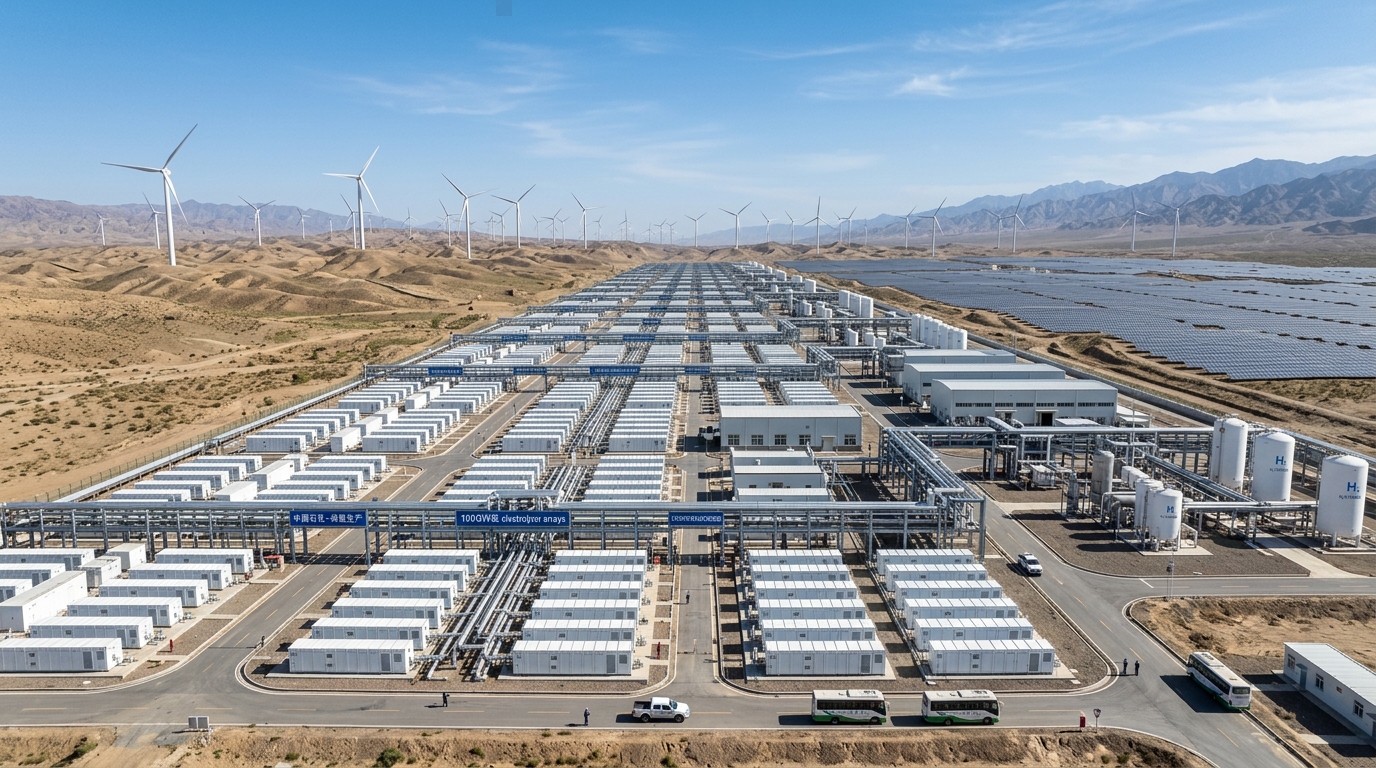
While the rest of the maritime world drafts white papers and debates the semantics of "well-to-wake" emissions, China is busy pouring concrete and installing electrolyzers. The National Energy Administration recently revealed that the country’s green fuel production capacity has hit a staggering eight million tons. This is not a theoretical projection for 2050; it is an industrial reality taking shape today across a landscape of wind farms and solar arrays. For a shipping industry desperate for scalable alternatives to heavy fuel oil, the center of gravity for the energy transition is shifting decisively eastward.
The Eight-Million-Ton Elephant in the Room
The scale of China’s green fuel capacity is difficult to overstate, especially when compared to the fragmented pilot projects seen elsewhere. According to the National Energy Administration (NEA), the nation has hit an eight-million-ton threshold that encompasses a spectrum of alternative energy sources. This figure serves as a loud signal to shipowners who have been hesitant to order dual-fuel vessels due to "fuel availability" concerns. China is effectively removing that excuse from the table by building the supply before the demand fully matures.
Within this eight-million-ton total, green hydrogen stands out as the primary growth engine. The current capacity has exceeded 1.1 million tons, a figure that includes both operational plants and those currently under construction. What is particularly striking is the velocity of this expansion. The operational portion—roughly 250,000 tons—has more than doubled in 2024 alone. This suggests that the "pipeline" of projects is no longer just a list of ambitious PowerPoint slides but a functioning industrial sector.
The remaining 900,000-plus tons currently under construction represent a massive bet on the future of global trade. These projects are the direct result of a strategic pivot initiated by the 2022 hydrogen policy, which provided the regulatory clarity investors needed. In the world of logistics, we often talk about "first-mover advantage," but China is pursuing something closer to "first-builder dominance." By the time European and American subsidies are fully unboxed, China may already control the lion’s share of the global green bunkering market.
Hydrogen: The Mother of All Alternative Fuels
To understand why 1.1 million tons of hydrogen matters, one must look at the downstream chemistry of maritime fuels. Hydrogen is the foundational molecule required to produce green methanol and green ammonia—the two frontrunners in the race to replace bunker C. Without a massive surplus of green hydrogen, "green" methanol is just a colorful name for a expensive chemical. China’s strategy treats hydrogen as the base layer of an energy pyramid, allowing them to pivot between different fuel types as market demand fluctuates.
This flexibility is crucial because the shipping industry remains divided on which fuel will eventually win. Maersk has placed heavy bets on green methanol, while other carriers are looking toward the energy density of ammonia. By scaling hydrogen production first, China ensures it can cater to both camps. They are building the refineries that can take that hydrogen and combine it with captured carbon or nitrogen, effectively future-proofing their position regardless of which engine technology gains the upper hand.
Furthermore, the deployment of electrolyzers—the machines that split water into hydrogen and oxygen—has become a Chinese specialty. Just as they did with solar panels and lithium-ion batteries, Chinese manufacturers are driving down the capital expenditure of electrolyzers through sheer volume. This creates a virtuous cycle: cheaper machines lead to cheaper hydrogen, which leads to more viable green fuels for the global fleet. It is a classic play from the industrial handbook that has served the country well in other sectors.
"China isn't just participating in the green fuel market; they are engineering the market's infrastructure while the rest of the world is still debating the blueprints."
The 2022 Policy Engine Behind the Surge
The current explosion in capacity did not happen by accident; it is the calculated result of the "Medium and Long-term Plan for the Development of Hydrogen Energy Industry" launched in 2022. This policy provided the essential "green light" for state-owned enterprises and private investors to pour capital into what was previously considered a high-risk sector. By defining hydrogen as a key component of the national energy system, the government eliminated much of the regulatory ambiguity that often stalls such massive infrastructure projects in more litigious jurisdictions.
This policy framework does more than just offer subsidies; it coordinates the entire value chain. It aligns the production of renewable electricity in the windy, sun-drenched western provinces with the fuel demand in the industrial eastern ports. In many ways, this is a logistics problem solved at the legislative level. The NEA’s role has been to ensure that the surplus of renewable energy—often wasted due to grid congestion—is diverted into hydrogen production, effectively turning "spilled" electricity into a storable, tradable commodity.
For the international shipping community, this policy stability is perhaps more important than the fuel itself. Shipowners operate on 20-year asset cycles and require certainty that the fuels they choose will be available for the life of the vessel. While Western policies often shift with election cycles, China’s 2022 mandate provides a 15-year roadmap. This long-term horizon allows for the kind of capital-intensive investments required to build eight million tons of capacity, providing a level of "bunker security" that is currently unmatched globally.
Electrolyzers: China’s New Export Juggernaut
The secret sauce in China’s green fuel recipe is the manufacturing of electrolyzers. Currently, Chinese-made alkaline electrolyzers are estimated to be 25% to 30% cheaper than their Western counterparts. This price gap is not just about lower labor costs; it is about the maturity of the supply chain and the ability to manufacture at a scale that European or American firms have yet to reach. When you are building a facility to produce 900,000 tons of hydrogen, a 30% reduction in capital expenditure is the difference between a viable project and a white elephant.
We are seeing a repeat of the solar industry’s trajectory from the early 2010s. Companies like Longi and Sungrow are rapidly pivoting their expertise from photovoltaics to hydrogen technology. By treating the electrolyzer as a mass-produced industrial product rather than a bespoke piece of laboratory equipment, they are dragging the cost of green hydrogen toward parity with fossil fuels. This technological edge ensures that China is not just the world’s biggest producer of green fuel, but also its biggest exporter of the hardware needed to make it.
For logistics managers and freight forwarders, this technological dominance has a direct impact on the bottom line. The cost of green fuels is the single largest barrier to decarbonization, often carrying a premium of 2x to 3x over traditional low-sulfur fuel oil. If China can successfully "commoditize" the production equipment, the "green premium" paid by shippers will shrink faster than anticipated. This could accelerate the adoption of green corridors and force a realignment of global bunkering routes toward ports that can offer these subsidized, high-volume fuels.
The Tech Angle: ALK vs. PEM
While Western manufacturers often focus on Proton Exchange Membrane (PEM) electrolyzers for their responsiveness to fluctuating power, Chinese firms have perfected the more traditional Alkaline (ALK) technology. ALK electrolyzers are heavier and less flexible but significantly cheaper to build at scale. By leveraging ALK for massive, grid-connected projects, China is prioritizing "tons per dollar" over technical sophistication—a strategy that aligns perfectly with the high-volume needs of the maritime industry.
Bunkering Hubs and the New Silk Road
The production of eight million tons of green fuel is only half the battle; the other half is getting it into the tanks of 24,000 TEU container ships. Ports like Shanghai and Ningbo-Zhoushan are already undergoing massive transformations to become the world’s premier green bunkering hubs. In early 2024, Shanghai successfully completed its first ship-to-ship green methanol bunkering operation, a milestone that signaled to the world that China’s infrastructure is ready for the new era of dual-fuel shipping.
This development poses a significant challenge to traditional bunkering giants like Singapore. Historically, Singapore has held the crown due to its strategic location and efficient fuel markets. However, if China can provide green fuels at a lower cost—produced domestically and piped directly to the berths—the incentive for ships to deviate to Singapore for refueling may diminish. We are witnessing the birth of a "Green Silk Road," where the fuel that powers global trade is produced, stored, and dispensed within a single, integrated economic ecosystem.
For port operators globally, the Chinese model serves as a blueprint for survival. The transition to green fuels requires more than just a few storage tanks; it requires deep integration with the national energy grid and chemical production facilities. The ports that succeed will be those that stop viewing themselves as mere transit points and start acting as energy hubs. China’s ability to co-locate eight million tons of production capacity near its primary export gateways gives its ports a competitive advantage that will be difficult for others to replicate without similar state-level coordination.
The IMO Shadow: Regulation Meets Reality
The International Maritime Organization (IMO) has set ambitious targets for the industry, including a 20% reduction in emissions by 2030 and "net-zero" by 2050. These dates have long felt like distant deadlines, but the recent MEPC 81 and 82 meetings have sharpened the focus on mid-term measures, including a potential global carbon levy. China’s massive scaling of green fuel capacity provides the industry with a vital "safety valve." Without a massive supply of alternative fuels, the IMO’s regulations would simply become an expensive tax on global trade rather than a catalyst for change.
The availability of eight million tons of fuel helps prevent what some analysts call "compliance panic." When regulations outpace supply, the price of compliant fuel skyrockets, leading to market distortions and increased costs for consumers. China’s proactive approach ensures that there is a physical product to back up the regulatory mandates. This is particularly important for the "Green Corridors" being established between Asia and Europe, which rely on a steady, predictable supply of zero-emission fuels at both ends of the journey.
However, the rapid rise of Chinese green fuels also introduces a new layer of complexity to the regulatory landscape. There are ongoing debates regarding the "color" and certification of these fuels. To meet EU and US standards, Chinese producers must prove that their hydrogen is truly "green"—produced using only additional renewable energy. The NEA’s data on renewable electricity surplus suggests that China is well-positioned to meet these traceability requirements, but the documentation and validation process will be a significant administrative hurdle for carriers and fuel traders alike.
"The maritime industry's net-zero ambitions are no longer limited by technology or policy, but by the physical volume of molecules available in the bunkering barge."
The Geopolitics of the Green Transition
The rise of China’s green fuel sector is occurring against a backdrop of intensifying geopolitical competition. While the United States uses the Inflation Reduction Act (IRA) to lure green investment with tax credits, and the European Union implements the Carbon Border Adjustment Mechanism (CBAM) to protect its domestic industries, China is simply building at scale. This create a fascinating tension in the global shipping market: carriers want the cheapest green fuel available to stay competitive, but they must also navigate a world where energy sourcing is increasingly viewed through the lens of national security.
We are already seeing the early stages of a "green trade war." There are concerns in Brussels and Washington that China’s dominance in electrolyzers and green fuels could lead to the same kind of dependency that characterized the era of Russian gas or Middle Eastern oil. For the shipping professional, this means that the choice of fuel is no longer just a technical or economic decision; it is a geopolitical one. A ship bunkering green methanol in Ningbo may face different regulatory scrutiny in Rotterdam than a ship bunkering in Houston, depending on how "green" the fuel is certified to be.
Despite these tensions, the sheer volume of China’s production—eight million tons—makes it an unavoidable partner in the maritime energy transition. You cannot decarbonize the world’s largest fleet without the world’s largest fuel producer. This reality will likely force a pragmatic cooperation between major trading blocs. Freight forwarders and logistics managers will need to become experts in "fuel provenance," tracking not just where a container is going, but what kind of molecule moved it and where that molecule was born. This adds a new layer of complexity to an already opaque global supply chain.
Safety and the Logistics of 'Spicy' Fuels
The transition to an eight-million-ton green fuel economy brings with it a host of logistical and safety challenges that the industry is only beginning to grasp. Unlike traditional heavy fuel oil, which is relatively stable and forgiving, the new generation of "spicy" fuels requires a much higher degree of care. Ammonia, for instance, is highly toxic and can be fatal if even small amounts are inhaled. Methanol, while easier to handle than ammonia, has a low flashpoint and burns with a nearly invisible flame, making fire detection and suppression a specialized task.
As China scales up production and bunkering, the industry must also scale its safety protocols. This isn't just about better fire extinguishers; it's about a fundamental shift in how we manage the documentation and compliance of dangerous goods. Every ton of green ammonia produced in a Chinese facility must be tracked, labeled, and handled according to strict international standards like the IMDG Code. The margin for error is significantly narrower than it was in the age of fossil fuels. One high-profile safety incident involving a green-fueled vessel could set the entire industry’s decarbonization timeline back by years.
Moreover, the logistics of storing these fuels at ports require entirely new infrastructure. Traditional tanks are often unsuitable for the corrosive nature of ammonia or the volatility of methanol. China is currently investing in specialized storage and pipeline systems to move these fuels from production sites to the water’s edge. For port operators, this means a massive capital reinvestment program. The digital systems used to manage these ports will also need to evolve, providing real-time visibility into fuel levels, pressure, and temperature to ensure that "green" doesn't accidentally turn into "catastrophic."
The Regulatory Angle: Certification is Key
As China’s green fuel reaches the global market, the focus will shift from quantity to quality. The "Green Hydrogen Standard and Certification" in China is being aligned with international norms to ensure that fuels exported to the EU or North America meet the rigorous "additionality" and "emissions intensity" requirements. For shippers, this means that every bunker delivery note will soon need to be accompanied by a digital certificate of origin, proving that the fuel was indeed produced using renewable energy and not just gray hydrogen with a better marketing budget.
How Exaqube Helps
The transition to a multi-fuel future, powered by China’s eight-million-ton capacity, introduces a level of operational complexity that legacy systems simply cannot handle. This is where DGSense becomes indispensable; as fuels like ammonia and methanol become commonplace, our AI-powered compliance engine ensures that every shipment and bunkering operation adheres to the latest IMDG codes and safety protocols, flagging risks before they reach the pier. Simultaneously, DataSense provides the real-time visibility needed to track the carbon intensity and certification of these new fuels across your entire fleet. For freight forwarders and carriers navigating this green transition, the ability to validate fuel provenance and safety documentation automatically is the difference between a seamless voyage and a regulatory nightmare.
Originally reported by [maritime-executive.com](https://maritime-executive.com/article/china-s-production-capacity-for-green-fuels-reaches-eight-million-tons)
Originally published at maritime-executive.com.