

Securing the Spirit: X-Press Feeders Bets on Bio-Methanol to Fuel the Feeder Future
TL;DR
X-Press Feeders signed a Letter of Intent for bio-methanol offtake to guarantee supply for its incoming dual-fuel fleet.
The agreement shifts the decarbonization focus from vessel hardware to the long-term security of the sustainable fuel supply chain.
This strategic move positions the feeder specialist to lead green corridors as regional carbon regulations like FuelEU Maritime tighten.
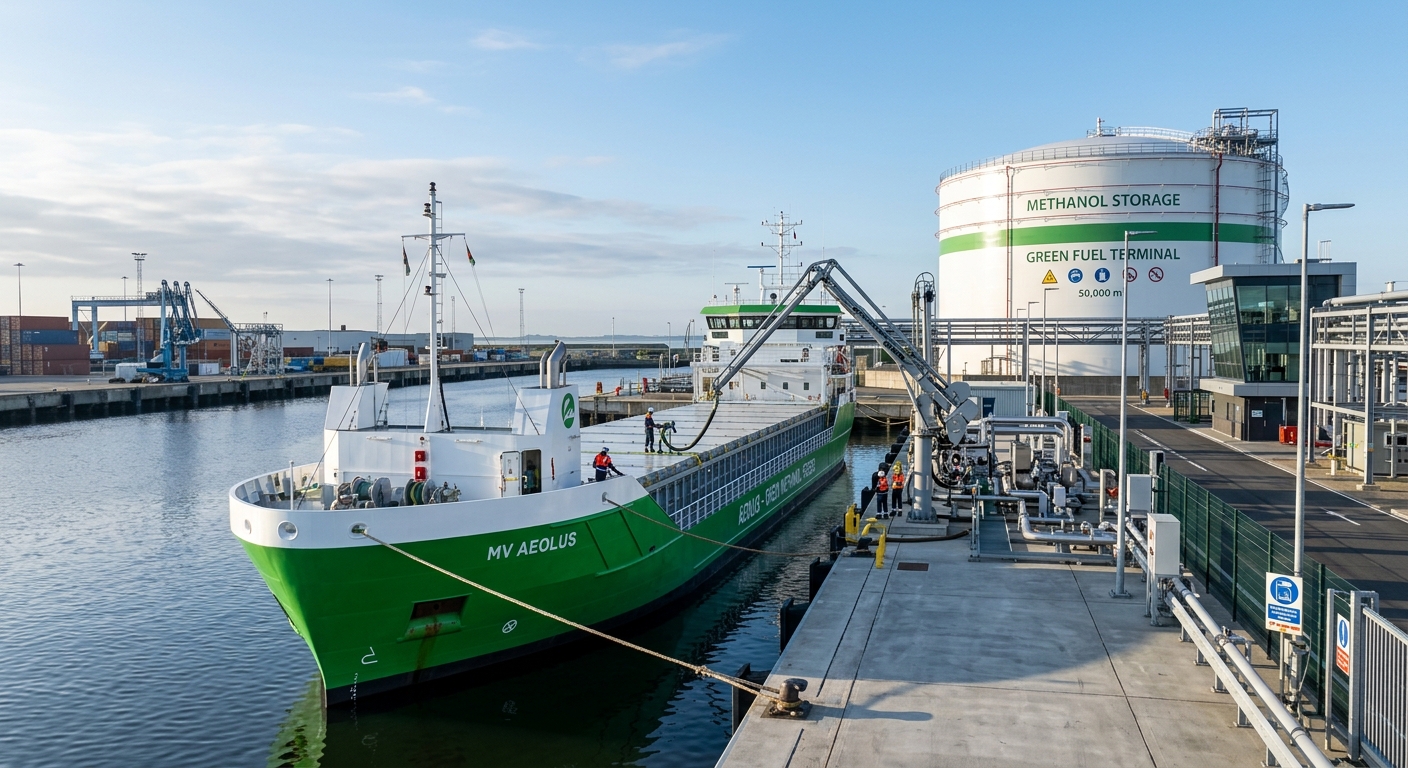
Shipowners are currently playing a high-stakes game of musical chairs where the chairs are green molecules and the music is the ticking clock of IMO 2030. X-Press Feeders recently secured its seat by signing a Letter of Intent (LOI) for bio-methanol offtake, ensuring its new dual-fuel vessels won't sit idle for lack of sustainable propellant. This move acknowledges a blunt reality: owning a green ship is a liability if you cannot find the fuel to run it. By locking in supply now, the feeder specialist is moving beyond the theoretical "readiness" of its fleet into the practical execution of carbon-neutral logistics.
The Strategic Weight of the Offtake Agreement
The maritime industry treats Letters of Intent like first dates in a very expensive courtship. X-Press Feeders has effectively told the fuel market that it is ready for a serious relationship with bio-methanol. This offtake agreement serves as a critical signaling mechanism. It tells fuel producers that the demand is not just a projection on a slide deck but a physical requirement for a fleet that is already under construction. Without these agreements, the "chicken and egg" problem of decarbonization remains unsolved. Producers will not build refineries without buyers, and shipowners will not buy engines without fuel.
X-Press Feeders is not just buying fuel; it is buying certainty. The feeder segment operates on razor-thin margins and tight schedules. A vessel waiting for a specific bunkering barge in a secondary port is a vessel losing money. By securing bio-methanol supply through an LOI, the company is attempting to bypass the inevitable supply crunch that will hit as larger carriers like Maersk and CMA CGM ramp up their own methanol consumption. It is a defensive maneuver dressed as an environmental one, ensuring that their green feeder network remains operational while others are still scouring the market for spot-market molecules.
This agreement also highlights the shifting power dynamics between shipowners and energy providers. Historically, a shipowner could pull up to almost any bunkering hub and expect a barge of heavy fuel oil to be waiting. The future looks much more like a closed-loop system. If you want the green fuel, you have to help finance the plant that makes it. These offtake agreements provide the "bankability" that fuel producers need to secure project financing. In essence, X-Press Feeders is helping to build the refinery it plans to use, a level of vertical integration that was once the exclusive domain of oil majors.
Why Methanol is Winning the Popularity Contest
Methanol has become the industry's favorite molecule because it is remarkably boring to handle. Unlike LNG, which requires cryogenic tanks and a constant fear of "boil-off," methanol stays a liquid at room temperature. You can store it in slightly modified conventional tanks. This simplicity reduces the capital expenditure for the ship and the complexity for the crew. For a feeder operator like X-Press Feeders, whose ships call at a high frequency of smaller ports, simplicity is a competitive advantage. You do not need a billion-dollar LNG terminal to refuel a methanol ship; you just need a well-placed barge and some basic safety protocols.
The "bio" part of the bio-methanol equation is where the math gets interesting. Bio-methanol is produced from sustainable biomass—think agricultural waste or forestry residues. This allows for a significant reduction in well-to-wake emissions compared to fossil-based methanol. While e-methanol (made from captured CO2 and green hydrogen) is the ultimate prize, bio-methanol is the pragmatic stepping stone. It is available sooner and at a slightly less eye-watering price point. X-Press Feeders is betting that being "mostly green" now is better than being "perfectly green" never.
However, methanol is not a magic bullet. It has roughly half the energy density of traditional fuel oil. This means you need twice as much tank space to go the same distance. For large ocean-going vessels, this is a headache. For feeders, it is a manageable trade-off. Feeder routes are shorter, and port calls are frequent. A feeder vessel can afford to lose a bit of cargo space to fuel tanks if it means staying compliant with tightening environmental regulations. The math works for the "short-sea" specialists in a way it doesn't always work for the giants of the trans-Pacific.
"The difference between a green ship and a stranded asset is a signed offtake agreement. Without the molecule, the engine is just a very expensive sculpture."
Feeders as the Vanguard of Decarbonization
Feeder networks are the unsung heroes of the global supply chain, acting as the capillary system that connects major hubs to smaller regional ports. They are also the perfect laboratory for new fuels. Because feeders operate on fixed, predictable routes within specific regions, they are the ideal candidates for "Green Corridors." If you can secure bio-methanol at two or three key ports in a regional loop, you have a fully decarbonized service. X-Press Feeders is leveraging this geographical focus to build a green ecosystem that is much easier to manage than a global tramp service.
The regulatory environment in Europe is currently the strongest tailwind for this strategy. The EU Emissions Trading System (ETS) and the upcoming FuelEU Maritime regulations are making fossil fuels increasingly expensive. By 2025, the cost of carbon will be a line item on every invoice. For a feeder operator in the Baltic or the Mediterranean, the "green premium" for bio-methanol starts to look like a "green discount" when you factor in the avoided carbon taxes. X-Press Feeders is positioning itself to offer its customers—the major deep-sea lines—a way to lower their overall scope 3 emissions through these green feeder links.
This regional approach also allows for more intimate partnerships with fuel producers. A local bio-refinery can sustain a regional feeder fleet much more easily than it can fuel a fleet of 24,000 TEU behemoths. We are seeing the emergence of a more localized, decentralized bunkering model. X-Press Feeders is at the forefront of this shift, proving that you don't need to solve the global fuel crisis to make a meaningful dent in your carbon footprint. You just need to solve the fuel crisis for your specific loop.
What The Numbers Say
The "Green Premium" for bio-methanol remains significant, with prices often 2x to 3x higher than conventional VLSFO on an energy-equivalent basis. However, with EU ETS carbon prices hovering around €70-€100 per tonne of CO2, the gap is narrowing. Analysts suggest that by 2030, the combination of carbon taxes and production scaling could bring bio-methanol within 20% of fossil fuel costs, making early offtake agreements like the one signed by X-Press Feeders look like a financial masterstroke in hindsight.
The Scramble for the Greenest Drop
The shipping industry is currently in a polite but desperate brawl with the aviation and chemical industries for sustainable feedstocks. Bio-methanol relies on organic waste, and there is only so much "trash" to go around. X-Press Feeders is entering a market where demand is projected to outstrip supply for at least the next decade. By signing an LOI now, they are effectively jumping the queue. They are ensuring that when the refinery opens its valves, X-Press Feeders is at the front of the line with a bucket.
The competition from the aviation sector is particularly fierce. Sustainable Aviation Fuel (SAF) often uses the same bio-intermediates as bio-methanol. Airlines have a much higher tolerance for fuel costs because fuel is a larger percentage of their operating expenses and they can pass costs to passengers more easily than a freight forwarder can pass costs to a shipper of low-value consumer goods. This makes the maritime sector's push for bio-methanol a game of economic chicken. X-Press Feeders is betting that by focusing on the feeder niche, they can carve out a dedicated supply chain that is less exposed to the whims of the global aviation giants.
There is also the matter of fuel integrity. Not all bio-methanol is created equal. The industry is moving toward a world of "Mass Balance" and "Book and Claim" systems, but for many shippers, the physical molecule matters. They want to know that the actual ship carrying their container is burning the actual green fuel. This requires a level of transparency and traceability that the bunkering industry has never had to provide before. X-Press Feeders’ agreement likely includes provisions for certification and sustainability auditing, turning the fuel supply chain into a data supply chain.
Regulatory Tailwinds and the Cost of Inaction
The International Maritime Organization (IMO) has a reputation for moving with the speed of a glacier, but the glacier has recently picked up pace. The revised greenhouse gas strategy aiming for net-zero by "around 2050" has set a clear trajectory. More importantly, the industry is shifting from "Tank-to-Wake" to "Well-to-Wake" accounting. This means it is no longer enough to have a ship that emits less at the funnel; you have to prove the fuel was produced sustainably. X-Press Feeders’ move into bio-methanol is a direct response to this holistic accounting of emissions.
In Europe, the FuelEU Maritime regulation is the real hammer. It mandates a progressively lower greenhouse gas intensity for the energy used on board ships. If you fail to meet the targets, you pay a penalty. If you exceed them, you can "pool" your compliance with other ships or even sell your surplus to other owners. By securing bio-methanol, X-Press Feeders is not just avoiding penalties; they are creating a compliance asset. Their green ships can potentially offset the emissions of the rest of their fleet, or provide a high-value service to partners who are struggling to meet their own targets.
This regulatory pressure is changing the definition of a "good" ship. It used to be about fuel efficiency and cargo capacity. Now, it is about the ship’s ability to digest a variety of expensive, low-carbon fuels without breaking down or breaking the bank. The X-Press Feeders LOI is a recognition that the regulatory burden is shifting from the technical office to the procurement office. The person who buys the fuel is now just as important as the person who designs the hull. In the new maritime economy, compliance is a procurement challenge.
The Methanol Club: Joining the Elite
When Maersk launched the Laura Maersk, the world’s first methanol-enabled container ship, it was a lonely pioneer. Today, the "Methanol Club" is getting crowded. CMA CGM recently completed its first bio-methanol bunkering in Shanghai, signaling that the French giant is no longer just an LNG advocate. X-Press Feeders joining this group is significant because it represents the democratization of the technology. It is no longer just the "Big Three" with deep pockets and massive ESG departments who are making these moves.
The entry of a major feeder operator into the bio-methanol space validates the fuel’s scalability. If the companies that move the containers for the big lines are going green, it creates a seamless low-carbon chain. A shipper can now book a cargo from a small port in Southeast Asia to a regional port in Northern Europe and have the entire journey covered by green vessels. This "end-to-end" green offering is the holy grail for retailers like IKEA or Amazon, who are under immense pressure to decarbonize their entire supply chain.
However, being a member of the club is expensive. The capital expenditure for dual-fuel methanol engines is roughly 10-15% higher than traditional engines. For a company like X-Press Feeders, which operates in a highly competitive and price-sensitive market, this is a bold financial bet. They are betting that the market will value carbon-neutral transport enough to pay a premium. It is a transition from being a low-cost commodity provider to a high-value service provider. The LOI is the first step in proving that this new business model is viable.
The Tech Angle
Methanol dual-fuel engines are surprisingly similar to their diesel counterparts, which is a major part of their appeal. The injection systems are more complex, and there are additional safety sensors to detect leaks (since methanol burns with an invisible flame), but the core mechanical principles remain the same. This means the training burden for crews is manageable compared to the steep learning curve of ammonia or hydrogen. For a feeder operator with a diverse and rotating crew pool, this "familiarity" factor is a significant, if often overlooked, benefit.
Connecting the Dots of Green Corridors
The concept of "Green Corridors"—specific trade routes where zero-emission shipping is supported by infrastructure and policy—is the current obsession of maritime planners. Most of the focus has been on the massive trans-oceanic lanes, but a corridor is only as green as its weakest link. If a container travels 10,000 miles on a green mega-ship only to spend the last 500 miles on a soot-belching old feeder, the "green" claim is diluted. X-Press Feeders is closing this gap, ensuring that the feeder leg of the journey is as sustainable as the ocean leg.
Ports like Rotterdam, Singapore, and Shanghai are already preparing for a multi-fuel future. They are investing in methanol bunkering barges and safety protocols. But for X-Press Feeders, the challenge lies in the second-tier ports. Will a small regional terminal in the Mediterranean or the Baltic be ready to bunker bio-methanol by 2026? This is where the offtake agreement becomes a tool for infrastructure development. By guaranteeing demand, X-Press Feeders gives these smaller ports the confidence to invest in the necessary bunkering equipment.
The long-term vision is a network of green hubs connected by green feeders. This requires a level of coordination between shipowners, fuel producers, and port authorities that the industry has rarely seen. The X-Press Feeders LOI is a catalyst for this cooperation. It moves the conversation from "what if" to "how much and when." As more feeder operators follow suit, we will see the emergence of a truly global green shipping network, rather than just a few isolated green ships on the major trade lanes. The feeder is no longer just following the mother ship; it is leading the way into the green future.
The Financial and Operational Risks of the Green Bet
While the move to bio-methanol is environmentally sound, it is not without significant risks. The first is price volatility. Bio-methanol is currently a niche product with a limited number of producers. Any disruption in the supply of biomass or a sudden surge in demand from other sectors could send prices skyrocketing. Unlike the well-established global market for heavy fuel oil, the market for bio-methanol is still in its infancy. X-Press Feeders is stepping into a market where the rules are still being written, and the price of the "green" molecule is anything but stable.
Operational safety is another concern. Methanol is toxic if ingested or absorbed through the skin, and as mentioned, it burns with a flame that is nearly invisible in daylight. This requires a complete overhaul of fire detection and suppression systems on board. It also requires a cultural shift for crews who have spent decades working with relatively stable fossil fuels. Training for the "methanol era" is not just a box-ticking exercise; it is a fundamental change in how ships are operated and maintained. X-Press Feeders will need to invest heavily in human capital to ensure their green fleet is as safe as it is sustainable.
Finally, there is the risk of technology obsolescence. While methanol is the current frontrunner, the industry is also exploring ammonia, hydrogen, and even nuclear propulsion. There is a non-zero chance that by 2040, methanol could be seen as a "bridge fuel" that was surpassed by a more efficient or cheaper alternative. By locking into offtake agreements now, X-Press Feeders is committing to a specific path. It is a calculated gamble that methanol will remain a viable and competitive part of the fuel mix for the next 20 to 25 years—the typical lifespan of a newbuild vessel. In the rapidly evolving world of green tech, 25 years is an eternity.
How Exaqube Helps
Transitioning to a multi-fuel fleet like the one X-Press Feeders is building introduces a new layer of data complexity that legacy systems cannot handle. This is where DataSense becomes indispensable, providing real-time visibility into fuel consumption and carbon intensity across a diverse fleet, ensuring that every drop of bio-methanol is accounted for and optimized. Furthermore, the complex billing structures of long-term offtake agreements and the fluctuating costs of carbon credits require the precision of InvoiceSense. By automating invoice validation and detecting billing disputes in the "green premium" era, InvoiceSense ensures that shipowners pay exactly what they agreed upon in their LOIs, protecting margins as fuel costs become more volatile.
The X-Press Feeders offtake agreement marks a shift from the aspirational phase of decarbonization to the operational one. As the maritime industry moves closer to 2030, the ability to secure sustainable fuel will become a primary differentiator between market leaders and laggards. We should expect a flurry of similar agreements as other operators realize that a green hull is useless without a green fuel supply. The race for the molecule has officially begun, and the feeder segment is proving that it has the agility to lead the pack.
Originally reported by [seatrade-maritime.com](https://www.seatrade-maritime.com/sustainability/x-press-feeders-signs-bio-methanol-offtake-loi)
Originally published at seatrade-maritime.com.